Rare Medieval Name Tags

A word of warning: this post may make you want to weep. Last week I blogged about tiny pieces of parchment, paper birch bark, and wood that were filled with short messages from individuals in Antiquity and the Middle Ages (check out Texting in Medieval Times). The snippets – from a soldier’s request for more beer to a duke’s shopping list – were made cheaply and with little care because the messages on them were not meant to be kept long. Although such ephemeral material doesn’t normally survive, it forms an important historical source: it provides a rare glimpse on everyday life in medieval times.

Erfgoed Leiden, HGW, Archiefnummer 519, Inv. nr. 3384 (15th century)
Fig. 1 – Erfgoed Leiden, HGW, Archiefnummer 519, Inv. nr. 3384 (15th century) – Photo EK

More than in any other medieval document I have seen, such an intimate view of medieval life is provided by a type of written object I encountered for the first time this week (Fig. 1). When visiting the restoration lab at the regional archives in Leiden (Erfgoed Leiden en omstreken) my eyes were drawn to a photograph on the wall that showed a tiny strip of paper from the fifteenth century. I returned the next day to order up the slips from the vault and see for myself what they were all about. Here is the powerful story of a collection of medieval name tags, which may be best consumed with a tissue handy by.

Name tags
The fifteenth-century strips are written in Middle Dutch and kept in the archive of the medieval Holy Spirit Orphanage in the city of Leiden (Dutch: Heilige Geest- of Arme Wees- en Kinderhuis). Founded in 1316, the orphanage was connected to the parish of St Peter (more here). The building is still there and is situated less than 100 meters from the massive Church of Hoogland (Hooglandse Kerk), which can be seen towering over the city from miles away. Until the middle of the twentieth century, the charitable organisation was responsible for the care of foundlings and children.

Erfgoed Leiden, HGW, Archiefnr. 519, Inv. nr. 3384, slip 1 (15th century)
Fig. 2 Erfgoed Leiden, HGW, Archiefnr. 519, Inv. nr. 3384, slip 1 (15th century) – Photo EK
Erfgoed Leiden, HGW, Archiefnr. 519, Inv. nr. 3384, slip 2 (15th century)
Fig. 3 – Erfgoed Leiden, HGW, Archiefnr. 519, Inv. nr. 3384, slip 2 (15th century) – Photo EK
Erfgoed Leiden, HGW, Archiefnr. 519, Inv. nr. 3384, slip 3 (15th century)
Fig. 4 – Erfgoed Leiden, HGW, Archiefnr. 519, Inv. nr. 3384, slip 3 (15th century) – Photo EK

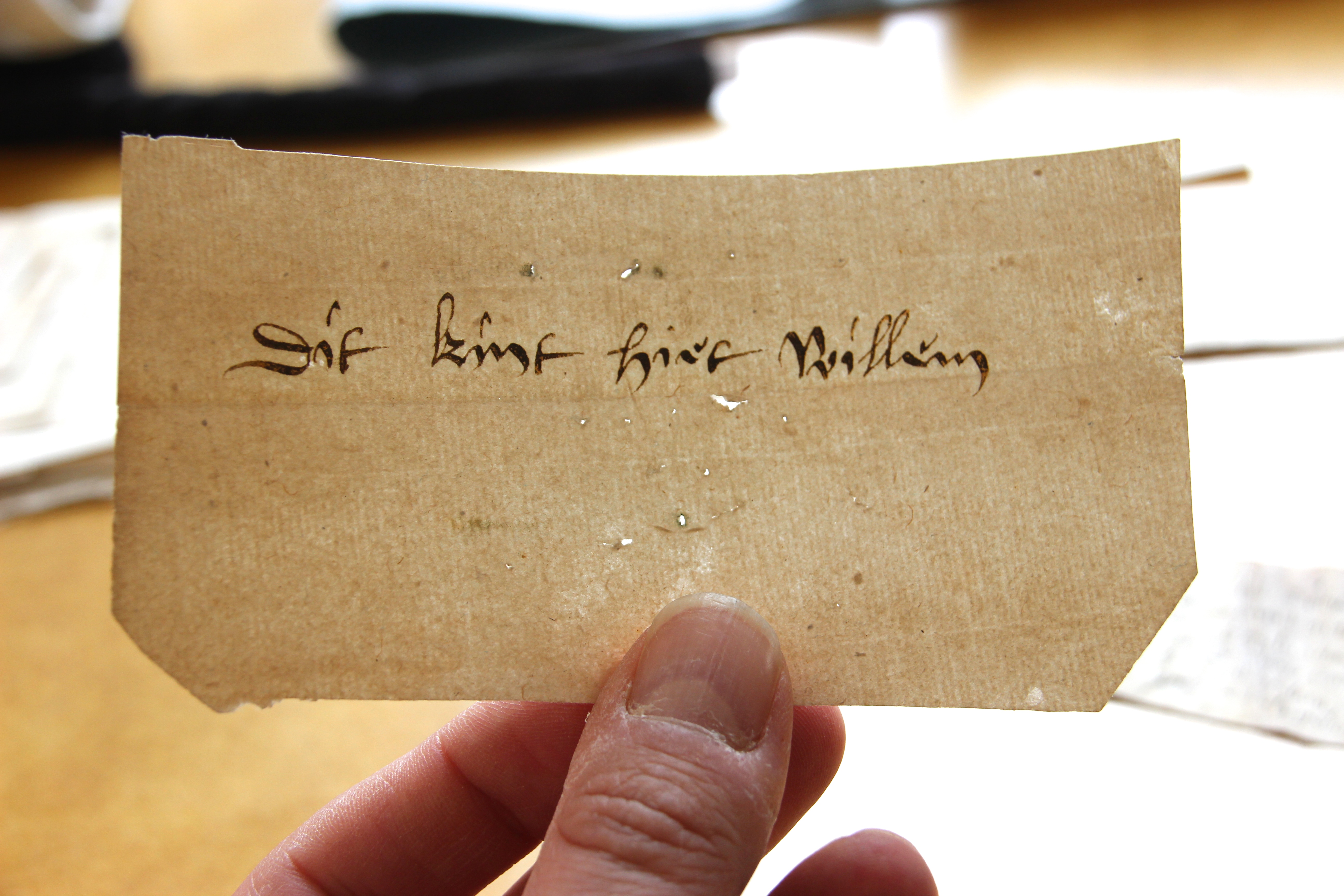
The paper slips, some of which are as small as 10×30 mm, add a real-world dimension to what we know about medieval orphanages. The examples above read: “This child is named Bartholomew” (Fig. 2: Item Dit kint heeit bartelmeis), “Job is his name” (Fig. 3: Job ist geheten), and “This child’s name is William” (Fig. 4: Dit kint hiet Willem). Each slip shows a pair of holes as well as the indent of a pin, which explains what we are looking at: name tags pinned on foundlings’ clothing as they entered the orphanage. As far as I know, this is the only surviving collection of medieval name tags, and it is a mystery why they were kept in the orphanage’s archive for five centuries.

Who wrote them?
The tag collection can probably be divided into two categories. Some were probably written by one of the masters of the orphanage. The ones seen in Figs. 2-4, for example, are done by an experienced, professional hand. Others, however, are written in a less experienced hand. These may well have been written by the parents. This is supported by the observation that these tags provide more details about the child (Figs. 5-6).

Erfgoed Leiden, HGW, Archiefnr. 519, Inv. nr. 3384, slip 4 (15th century)
Fig. 5 – Erfgoed Leiden, HGW, Archiefnr. 519, Inv. nr. 3384, slip 4 (15th century) – Photo EK
Erfgoed Leiden, HGW, Archiefnr. 519, Inv. nr. 3384, slip 6 (15th century)
Fig. 6 – Erfgoed Leiden, HGW, Archiefnr. 519, Inv. nr. 3384, slip 6 (15th century) – Photo EK

The one seen in Fig. 5 (again with a clear pin mark) reads: “This child is called Cornelius and belongs to a painter whose wife is a wool comber” (Dit kijnt heet cornelis dit hoet een schilder een schilder toe sijn wijf is een kemster). On the tag in Fig. 6 we read “This child is baptised and her name is Mariken” (Dijt kijnt is ghekorstent ende haerren name is mariken). Both show how some children – whether found in the street or dropped off at the orphanage – entered the orphanage with some family history attached, literally.

The only parchment tag provides a particularly detailed history (Fig. 7).  It reads “My mother gave me an illegal father, which is why I was brought here as a foundling. Keep this note so that they can pick me up again later. I was baptised and born on St Remigius day.” (Mijn moeder min een onrecht vader gaf daer om ben ic voer een vondelinck gebracht, bewaert dit briefken v[…] opdat nae min weder halen sal ic ben gedopt ende op Remigius dach geboren.) As in the case of Fig. 5-6, it is very likely that the information on this note was provided by the parents, probably as they dropped off their child.

Erfgoed Leiden, HGW, Archiefnr. 519, Inv. nr. 3384, slip 5 (15th century)
Fig. 7 – Erfgoed Leiden, HGW, Archiefnr. 519, Inv. nr. 3384, slip 5 (15th century) – Photo EK

Accompanying booklet
The ten or so surviving slips are kept together with a fifteenth-century booklet, in which they may, in fact, have traveled through time. The title on the first page tells us what we are dealing with: “The Child Book: How the Children Came Here” (Fig. 8: Item dat kijnderbock hoe dat die kijnder hier ghecomen sijen).
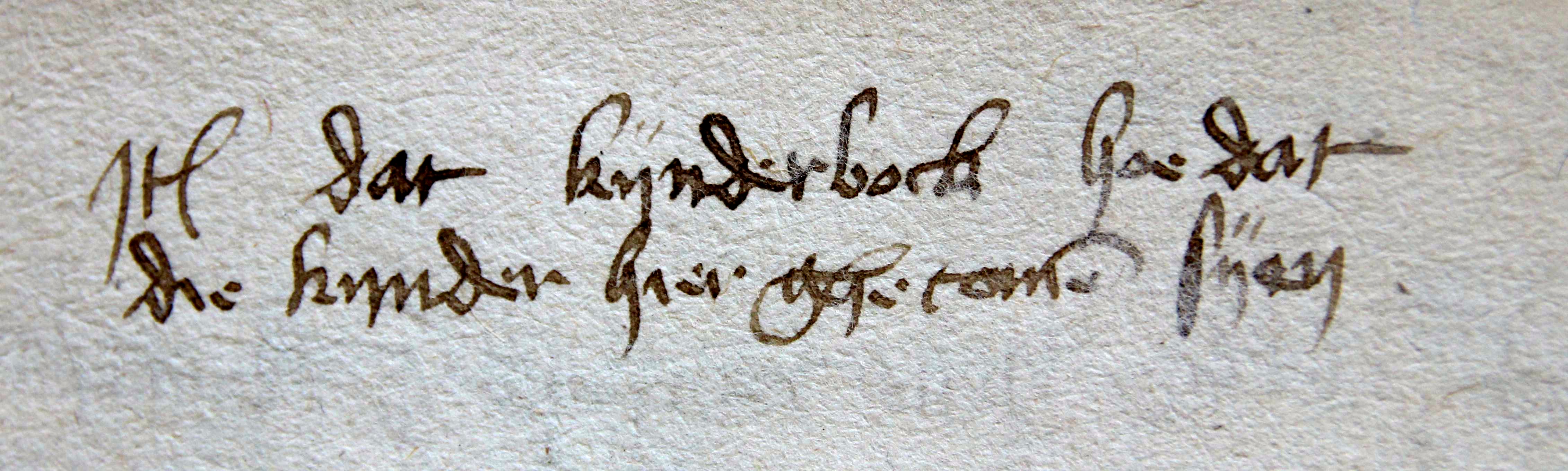
Erfgoed Leiden, HGW, Archiefnr. 519, Inv. nr. 3384, booklet (15th century)
Fig. 8 – Erfgoed Leiden, HGW, Archiefnr. 519, Inv. nr. 3384, booklet (15th century) – Photo EK

The booklet forms the counterpart to the labels, for it registers the orphans and provides information about the location where they were found. We may presume that the foundlings entered the house, often as babies, were tagged, and then processed. However, the entries in the book also contains brief reports from individuals who found foundlings in public spaces and came by to drop them off at the orphanage. The stories on the fifty-odd pages are truly heartbreaking.

Erfgoed Leiden, HGW, Archiefnr. 519, Inv. nr. 3384, booklet entry 2 (dated 1492)
Fig. 9 – Erfgoed Leiden, HGW, Archiefnr. 519, Inv. nr. 3384, booklet entry 2 (dated 1492) – Photo EK

On page 33 the following entry is found (Fig. 9). “Item, a child came to us without a name on the Thursday before the feast of St Peter in Chains. And we named it Peter, in the year 1502, for he was found in the Church of Our Lady under a bench.” (Item ons is en kijnt an ghekoemen sonder maem des donnersdacx voer sijnte pieters dach ad vynckula [St Peter in Chains] ende vij hietten pieter int jaer [1502] ende vas gheleit in onsser frouwen kerc onder een banck).

On page 7 a story with unhappy ending is penned down, by two scribes under the heading “anonymous” (sonder naem) (Fig. 10).

Erfgoed Leiden, HGW, Archiefnr. 519, Inv. nr. 3384, booklet entry 2 (dated 1491)
Fig. 10 – Erfgoed Leiden, HGW, Archiefnr. 519, Inv. nr. 3384, booklet entry 2 (dated 1491) – Photo EK

The first writes “Item a child was found in the church of St Peter and we named it Luke, on the Sunday before St Luke [= 18 October] in the year 1491. It looked like a newborn child to us, and it had been placed on the altar of St Agnes.” A second hand, in a slightly browner ink, added a short line, sometime later: “Luke died around St Catharine’s day [= 25 November] in the same year.” (Scribe 1: Item een kijnt ende vas ghevonden in sinte pieters kerc ende wij hietent Lucas op die zonnendach voer sinte Lucas anno [1491] ende was een nuo borun kijnt als ons dachten ende lach op sinte aegten altaer. Scribe 2: Lucas starf omtrent sinte katrinen dach actum voerseit.) The second scribe then crossed out the entry in the register.

These narratives form a powerful accompaniment to the paper slips. They report how and where the foundlings were found, and when they came to the orphanage with a paper name tag pinned on their clothes. Handling the paper slips in the archives is a heartbreaking experience: to think that they were made for the sole purpose of providing information about a child whose life was about to change dramatically. The handwriting underscores the emotions that must have been felt by the parents: the text is written in a scruffy manner, often with mistakes in spelling and grammar. For them it must have been a difficult task to write down these mini histories, in more ways than one.

Postscriptum – More on the history of the orphanage in Kees van der Wiel, ‘Dit kint hiet Willem’. De Heilige Geest in Leiden – 700 jaar vondelingen, wezen en jeugdzorg (Leiden: Primavera Pers, 2010), which also features some of the slips. With many thanks to Erfgoed Leiden for letting me photograph the name tags and use them for this post; and to Ed van der Vlist (Royal Library, The Hague) for his help with some readings. Just to emphasise, while I studied and transcribed them, I did not discover the tags, which featured in an exhibition some years ago.

Texting in Medieval Times

We all do it a few times per day: shooting a friend a text message with our phones. Doing so has become routine and we don’t really think about it: just grab your device, hold it up, and type a few words quickly and on the fly. Both the speed and short lifespan of text messages are responsible for its most peculiar features: they are written in a special language of short words and a high volume of abbreviations, and they come with the built-in understanding that there will likely be typos included. Interestingly, this hurried and cursory manner of communicating was quite common in medieval times, while its roots can be traced back to Antiquity. This post shows how people sent each other short messages before the invention of electricity and the phone: hastily, cheaply and with a modest amount of attention. “My soldiers have run out of beer, please send some!”

Antiquity

British Museum, 1986,1001.64, aka Tab. Vindol. II.291 (dated to 97-103 CE)
Fig. 1 – British Museum, 1986,1001.64, aka Tab. Vindol. II.291 (dated to 97-103 CE) – Source

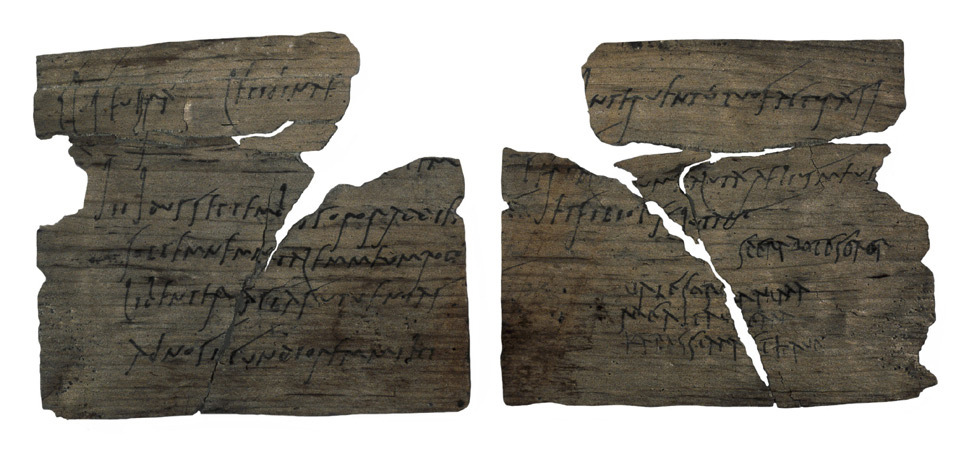
The idea for this post was sparked by an image of a wooden writing tablet that was written almost two thousand years ago (Fig. 1: I encountered it in a news letter from calligrapher Patricia Lovett). The tablet was dug up some time ago in a Roman army camp just south of Hadrian’s wall, in the north of England. Some 400 wood tablets with correspondence were found in the house of the commander, Flavius Cerealis, prefect of the Ninth Cohort. Remarkably, the tablets are only 1-3 mm thick, about the size of a modern postcard (more about the fortress here and about the correspondence here).

The one in Fig. 1 is particularly charming and personal. It invites the commander’s wife, Sulpicia Lepidina, to her sister’s birthday party. The latter writes: “On 11 September, sister, for the day of the celebration of my birthday, I give you a warm invitation to make sure that you come to us, to make the day more enjoyable for me by your arrival. […] Give my greetings to your Cerialis. My Aelius and my little son send him their greetings. I shall expect you sister. Farewell, sister my dearest soul, as I hope to prosper, and hail.” (Source) Astonishingly, with this tiny scrap of no more than 223 mm wide we have in our hands a two-millennium-old text message sent between two sisters, concerning a matter as trivial as a birthday. As scholars have remarked, this is one of the oldest surviving specimens of a woman’s handwriting, which makes the tiny scrap even more memorable.

Wooden shaft with nib excavated at Vindolanda
Fig. 2 – Wooden shaft with nib excavated at Vindolanda (late Antique) – Source

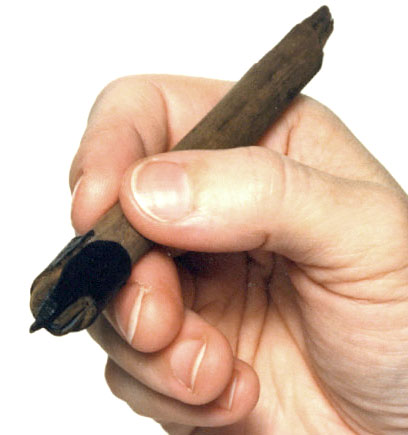
Produced with wooden pens with stuck-on nibs (Fig. 2), the 400 surviving text messages also include correspondence from the field, likely sent by courier.  The sub-commander Masculus writes to Flavius Cerealis, his superior: “Please, my lord, give instructions as to what you want us to have done tomorrow. Are we to return with the standard to the crossroads all together or [only half of us. Also,] my fellow soldiers have no beer. Please order some to be sent.” (Tab. Vindol. III 628, more here). This great (oldest-surviving?) order for beer, no doubt meant to be thrown out, survives because the earth preserved the wood on which it was written.

Middle Ages

Leiden, Bibliotheca Thysiana, Archive found in book binding (15th century)
Fig. 3 – Leiden, Bibliotheca Thysiana, Inv. Nr. 2200 H, Archive found in book binding (15th century) – Photo EK

Similar short logistical messages survive from medieval times, although their manner of survival is different. Fig. 3 shows waste material discovered in a book binding by students of Leiden’s Book and Digital Media Studies MA-program, for which I teach. A total of 132 paper slips were pressed together to form a board made out of “cardboard”. Quite unusual is the origins of the material: the recycling bin of a small court near Heidelberg, belonging to an unknown duke. The material is not your usual archival material – charters, accounts and whatnot – but mostly concerns ephemeral material that is mostly lost from medieval times: “yellow sticky notes” that were sent from one servant to another, such as the one seen in Fig. 4. The scrap was written by the chamberlain (“hofmeister”) and it requests the amount of six guilders from the duke, whose servant is the recipient of the message.

Fig. 4 – Leiden, Bibliotheca Thysiana, Inv. Nr. 2200 H, Chamberlain note from 1461 (front)
Leiden, Bibliotheca Thysiana, Chamberlain note from 1461 (back)
Fig. 5 – Leiden, Bibliotheca Thysiana, Inv. Nr. 2200 H, Chamberlain note from 1461 (back) – Photo Giulio Menna

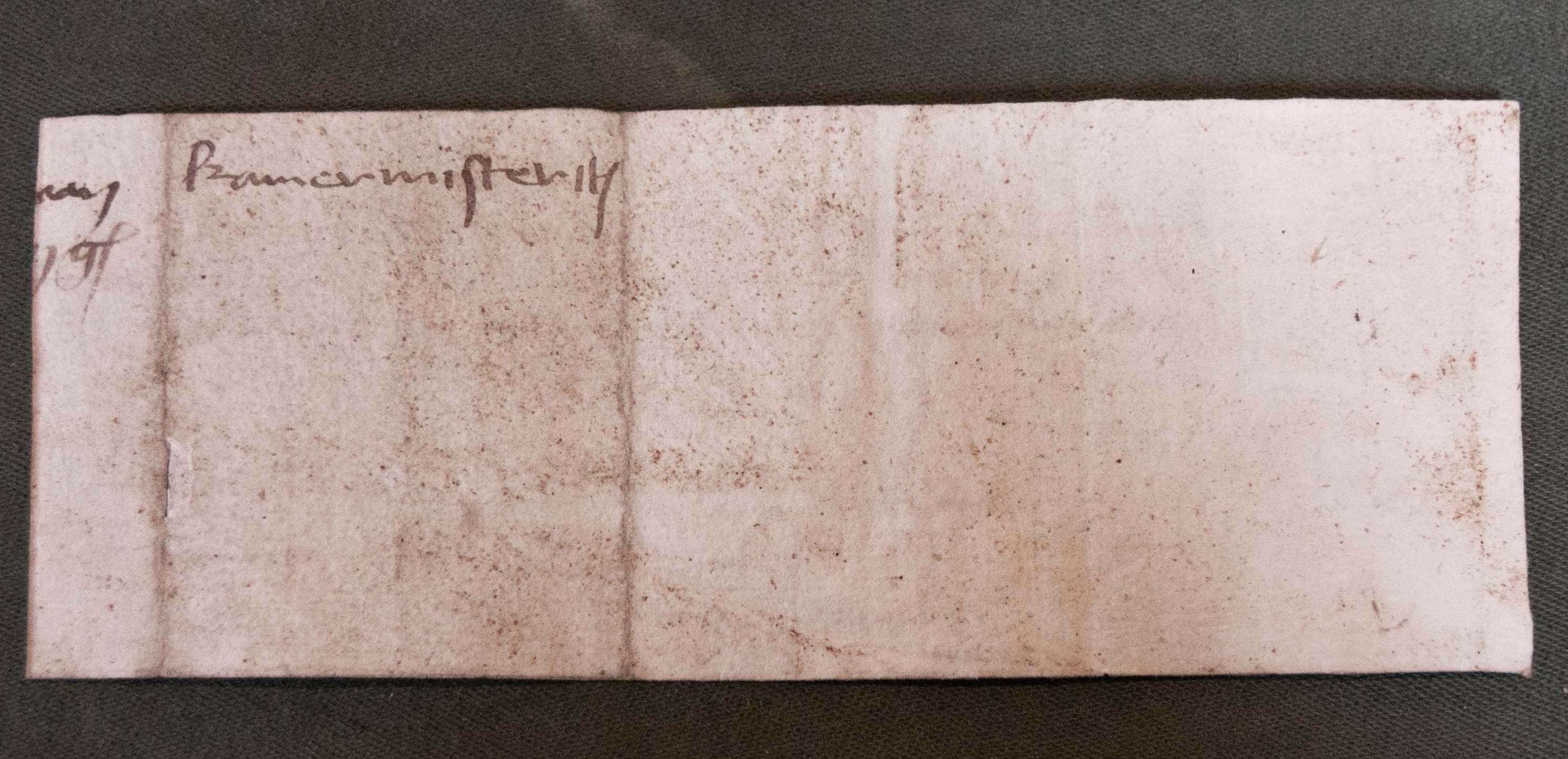
The back of the message (Fig. 5) also adds to our understanding of this hidden world of medieval text messaging. It shows to whom the note needed to be delivered (“kamermeister”) but also that it was folded into a small package for transportation (note the two folds). Another interesting note is a request to purchase some wild roses in Heidelberg, while making sure “to include some that are still in the bud.” (More about this case in this blog post.) Many of these slips were produced from recycled charters or account books. The messages were either written on their back (verso), or on a strip that was cut from their (blank) margin, as still visible in Fig. 5 (note the half words next to the word “kamermeister”). Why use a good sheet of paper if the message would be deleted immediately after use?

Time Capsule
Both the Vindolanda tablets and the medieval scraps that emerged from an early-modern binding form a time capsule with everyday conversations that do not normally survive from the past. We meet every-day people doing every-day things. Their manner of expressing themselves is untainted in that they do not try to be literary or witty, but merely convey a short message. They are part of a type of writing that was produced for short-term use and, ultimately, destruction. In that sense the messages from Antiquity and medieval times are not unlike the class notes I blogged about in the past, scribbled down by students and young children (Fig. 6) – more about notes and the bark sample in this post.

Birch bark strip used by the student Onfim, dated 1240-1260
Fig. 6 – Birch bark strip used by the student Onfim, dated 1240-1260 – Source, blogmore

The parallel with the birch bark notepad is striking for another reason as well: it confirms that individuals in the past selected cheap materials for items that were meant for short use only. In that sense it makes perfect sense that the “text messages” discussed above were written on things that were just lying around: thin pieces of wood and slips of waste in a recycling bin.

While the caches from Vindolanda and Leiden are remarkable, there are actually plenty of time capsules still out there. The average archive in Europe will contain several boxes filled with medieval waste material, which usually include a wide range of recycled “transitory” material, such as letters and notes (Fig. 7).

Maastricht, Archives, Box 384 (medieval waste)
Fig. 7 – Maastricht, Archives, Box 384 (medieval waste) – Photo EK

If the paper and parchment slips are the medieval equivalent of our modern text messages, written in a cursory fashion and forgotten about almost immediately after receipt, these archival boxes are like the memory chips of our phones. They allow us to read conversations deleted hundreds of years ago, connecting us to real medieval individuals doing real medieval things.

Postscriptum: as pointed out by Sarah Bond (@SarahEBond), similar to the genre discussed in this post is the ostrakon tradition from Antiquity, whereby short texts (quotes, notes and drafts) were written on pieces of broken pottery. Sarah forwarded this specimen with a quote from Homer; other examples are found in this Tumblr post I wrote some time ago.

Book on a Stick

Both medieval manuscripts and their modern counterparts are designed to accommodate human readers. Our two hands can keep an open book under control with ease by applying gentle pressure on the outer margins of the pages. Release the pressure with your right hand and a page lifts up in the air, just enough to conveniently flip it. With a rustling sound it travels from right to left, moved along by an impatient reader that is left in suspense for a second or two. The proportions of the page, too, are designed to accommodate consumption by human beings. Our eyes can handle only a small number of consecutively placed words, no more than eight or so, depending on the size of the letter. As a consequence, medieval page design shifted to presenting a text in two columns rather than one, a transition that occurred over the course of the twelfth century.

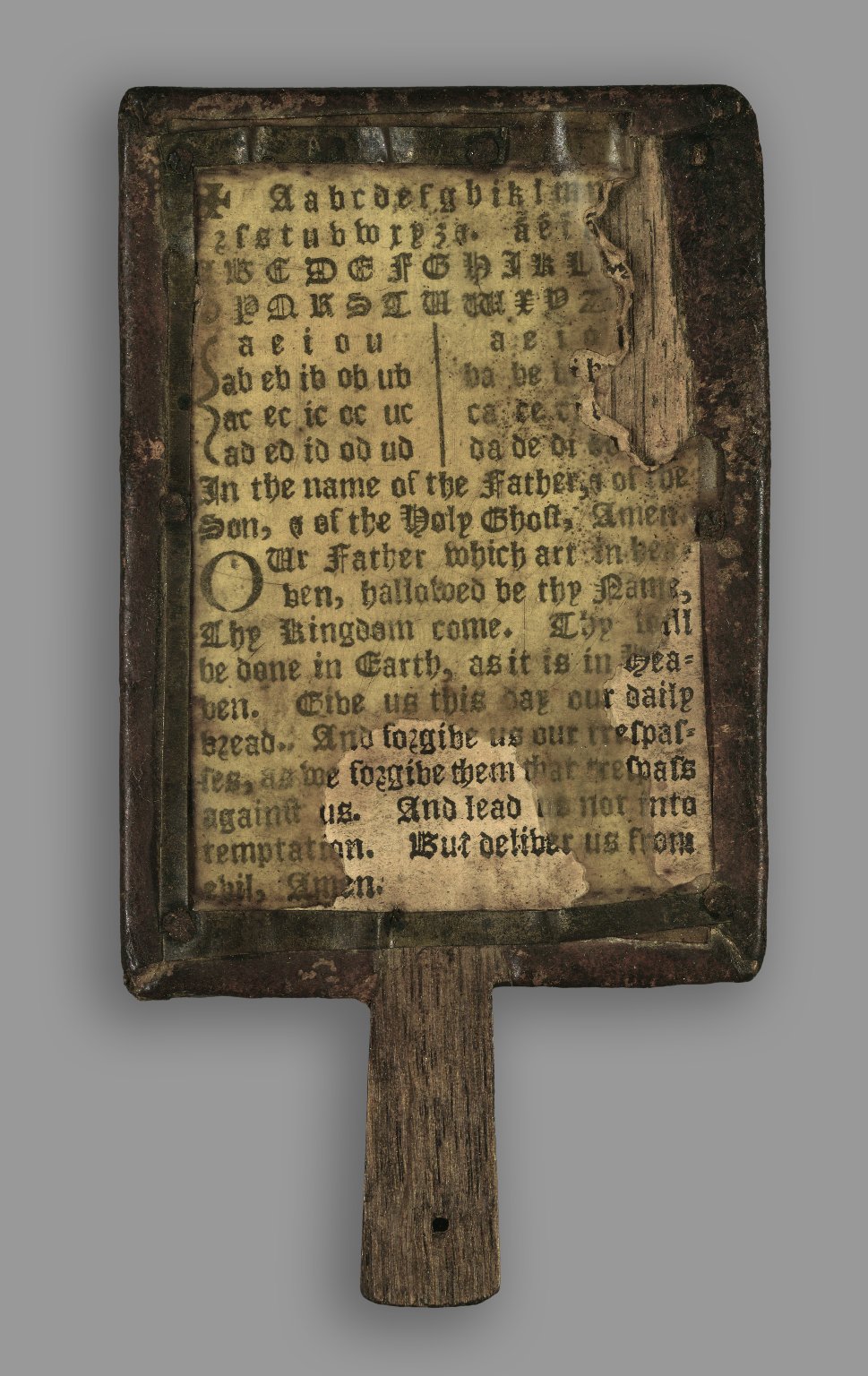
This relationship between book design and human anatomy is seen most vividly in a particularly peculiar bookish object that thrived in the sixteenth, seventeenth and eighteenth centuries: the hornbook (Fig. 1).

Washington, Folger Shakespeare Library, STC 13813.6 (dated 1625)
Fig. 1 – Washington, Folger Shakespeare Library, STC 13813.6 (dated 1625) – Source

This charming device is a primer: a text used by children as they were learning to read. It contains the alphabet (naturally), but also a small collection of short texts, such as the Lord’s Prayer and Hail Mary (more here and here). Its design reflects perfectly how the material format of books was customised for use by human beings: its user could easily grab a hornbook with one hand and hold it up at eye height. With his other hand the user could then duplicate the letters before his eyes. Two important things stand out when one observes the tradition: the variety of materials used to produce hornbooks – which were made of such materials as wood, lead and gingerbread – and its time of invention, which predate the proposed origins in current scholarly literature.

Materials
The heart of the hornbook is text, albeit a very small amount of it. In fact, it may well be the shortest read to survive from the early-modern period. Most hornbooks from that time are made out of wood. The pupil’s “required readings” were printed on a sheet of paper that was subsequently covered by a thin piece of horn for protection – hence the object’s name. The result is a remarkably sturdy object, which you can drop without damaging it, a minimum requirement for something used by young kids.

Washington, Library of Congress, 102.3 (18th century)
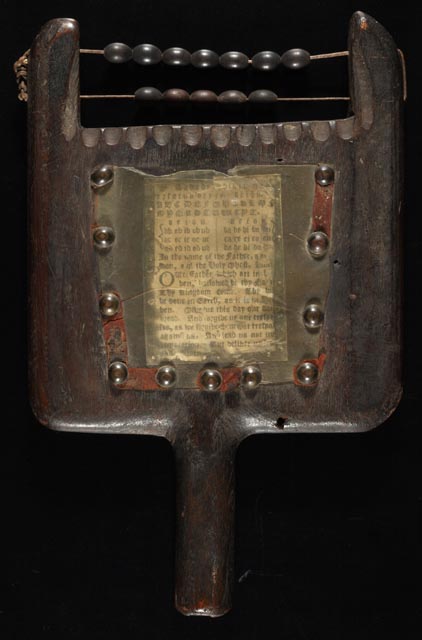
Fig. 2 – Washington, Library of Congress, 102.3 (18th century) – Source

Several surviving hornbooks show that the device was also used to teach kids to add and subtract. The one seen in Fig. 2, which dates from the eighteenth century, has a nifty add-on: an abacus. This particular specimen shows the end of the hornbook’s development, which appears to have become more sophisticated over time. The one in Fig. 2 contains another novel feature: the sheet of paper can be removed from behind the horn and replaced by another text, which may perhaps even be found on the reverse (here is another example). This late model is rather like an iPad with several apps loaded, one of which can even be updated when needed!

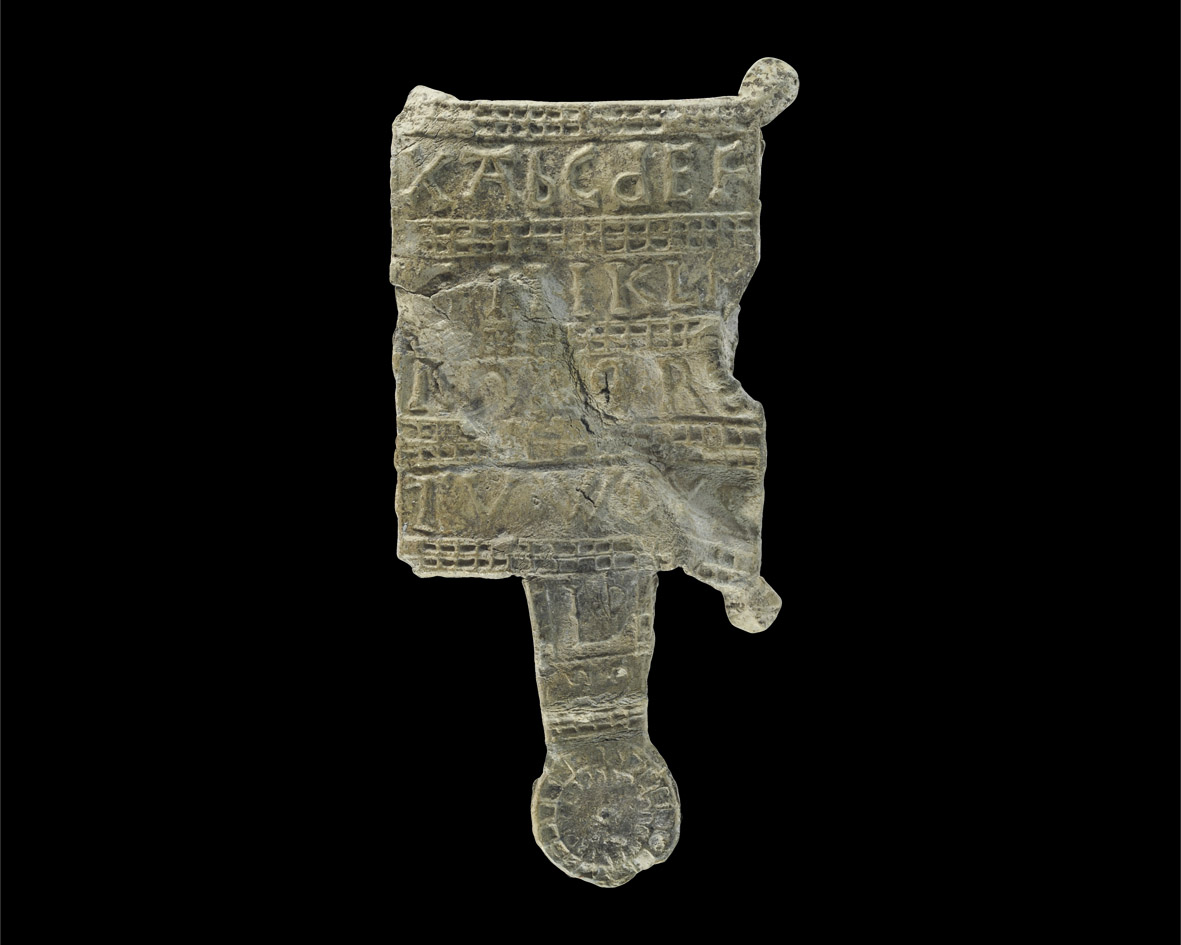
Other hornbooks were made out of even sturdier materials, such as ivory and lead (Fig. 3). The last one must have been particularly cheap and easy to produce, probably with the help of a mould. This specimen shows that the hornbook was subject to mass production, like its cousin, the printed book.

Timeline Acutions, Lot_903 (17th century)
Fig. 3 Timeline Acutions, Lot 903 (17th century) – Source

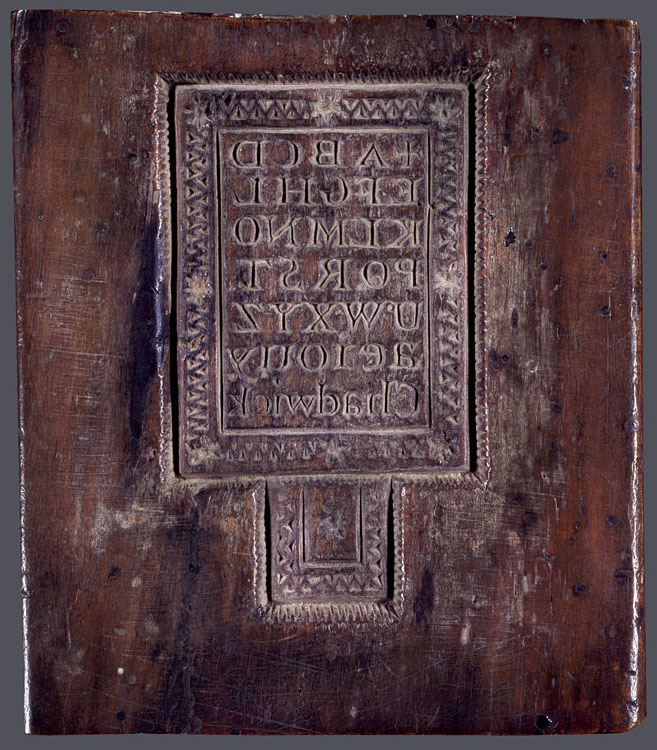
Quite different is the hornbook seen in Fig. 4. This wooden slab could be used to produce a gingerbread hornbook, handle and all. The tradition of this particularly tasty type of hornbook goes back to the seventeenth century. The English poet Matthew Prior (d. 1721) mentions it in one of his poems: “To Master John the English maid / A horn book gives of ginger-bread / And that the Child may learn the better / As he can name, he eats the letter / Proceeding thus with vast delight / He spells, and gnaws from left to right” (source). Although a peculiar book, the gingerbread version of the hornbook probably wins the prize for best didactical tool: what better reward than to eat the letter you were just able to read out loud?

Columbia University Library, RBML, Plimpton Hornbook 6 (England, 18th century?)
Fig. 4 – Columbia University Library, RBML, Plimpton Hornbook 6 (England, 18th century?) – Source

Medieval origins
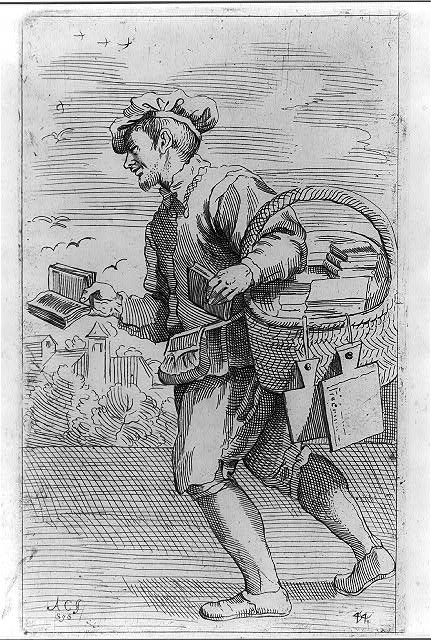
While the heyday of the hornbook was no doubt the early-modern period, the scholarly literature will also tell you that this bookish device was in used in the fifteenth century, during the late medieval period. In fact, publications on the topic stress that there are also handwritten – medieval – versions of the device. Peculiarly, I wasn’t able to find one, except for this early-sixteenth-century specimen. Even illustrations showing hornbooks “in the wild” date from the seventeenth century at best, such as the pair hanging from the chapman’s basket in an engraving from 1646 (Fig. 5).

Annibale Carracci, 'Tavolette, e Libri per li putti’ (1646)
Fig. 5 – Annibale Carracci, ‘Tavolette, e Libri per li putti’ (1646) – Source and more

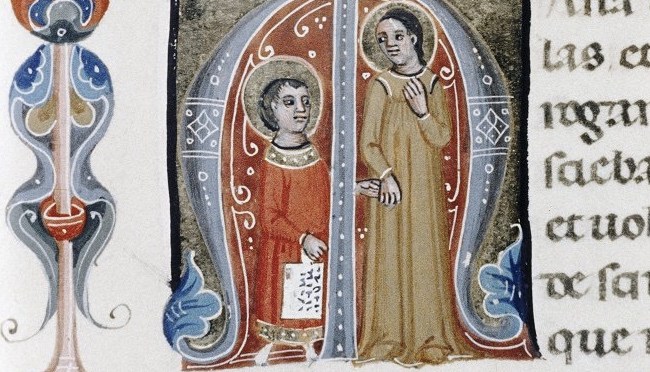
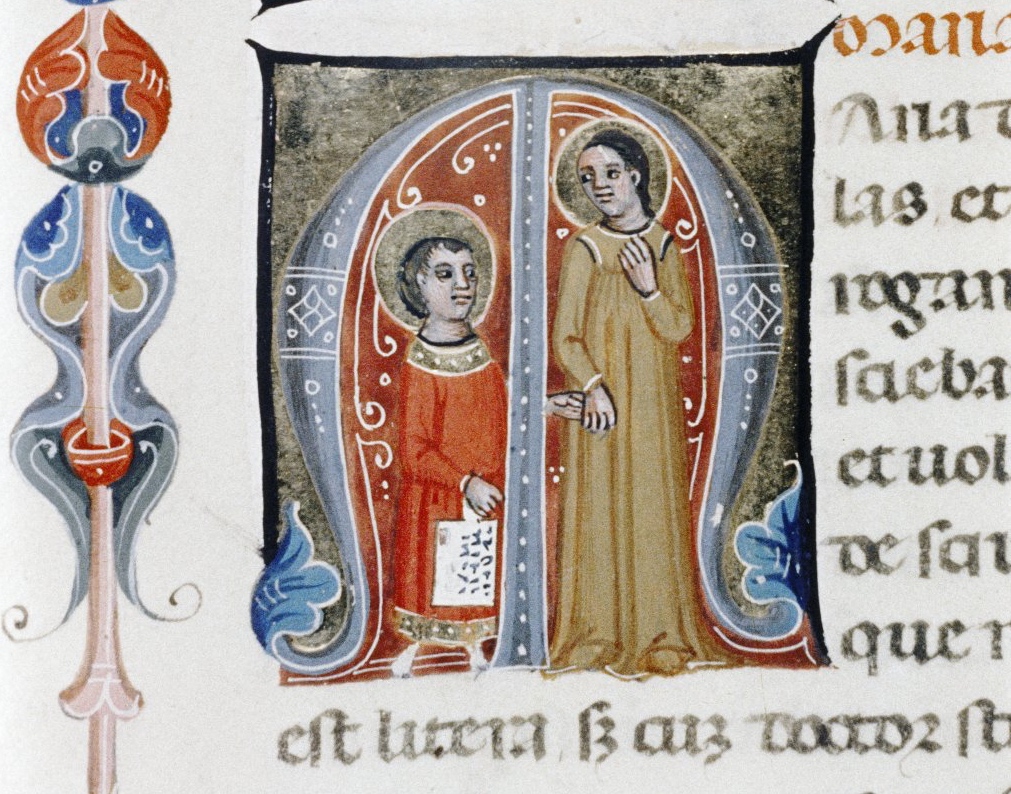
So is the hornbook a post-medieval invention? I was about to draw this conclusion, given the lack of evidence predating the early-modern period, when I coincidentally encountered the following illustration in a 14th-century Italian manuscript with an unidentified devotional text about Mary, the mother of Christ (Fig. 6-7).

Oxford, Bodleian Library, Canon. Misc. 476 (14th century).
Fig. 6 – Oxford, Bodleian Library, Canon. Misc. 476 (14th century) – Source
Detail of Fig. 0.
Fig. 7 – Detail of Fig. 6.

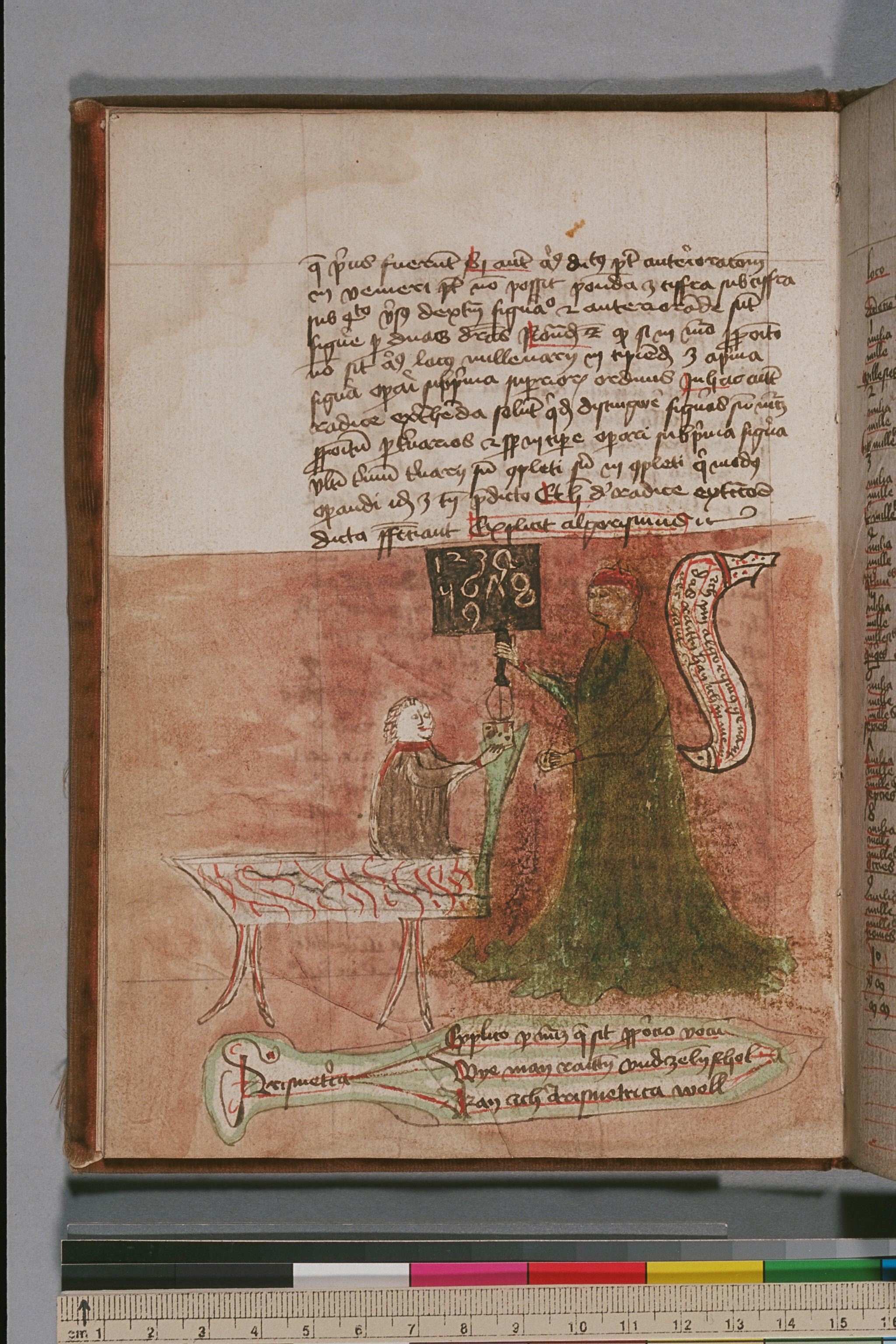
The image shows Christ being brought to school by his mother. He is bringing his “textbook” to class: a hornbook, which dangles from his wrist by a string, just like many of the later specimens did (see the hole in the handle in Fig. 1). Quite intriguingly, we are shown a real medieval snapshot of how children carried their hornbook to and at school. More importantly, it shows that the hornbook was indeed a medieval invention. Some further digging revealed additional visual evidence of hornbooks being used in before the age of print (Fig. 8).

Columbia University, Plimpton MS 184 (15th century)
Fig. 8 – Columbia University, Plimpton MS 184 (15th century) – Source

The manuscript, which was produced in Germany in 1440-1460, shows a teacher holding up a hornbook, using it to show Arabic numerals to a pupil in front of him. The German text bubble next to the scene is very positive about this teaching moment: “With calculus and numbers, I can be a star in arithmetic!” While it was produced somewhat later than the Italian example in Fig. 6, the setting in which the hornbook was used is the same: a context where basic information about letters and digits is conveyed to young pupils. While no actual hornbooks appear to survive from the medieval period, these visual representations show that educating young children was also the driving force behind the production of hornbooks in the age before print.

Dirty Medieval Books

When you use something for a thousand years, it is bound to get dirty. Medieval books often show stains and marks on their pages, usually from readers who did not always take very good care of the objects. Medieval books also collected a lot of loose dirt, which sometimes falls out when you thumb through their pages as a modern-day book historian – naturally with clean hands, though preferably without white gloves (here is why). While this dirt is often simply junk, the bits and pieces – twigs, pieces of leaves, dried flowers, pins – may also have had a function. A dried leaf from a tree may for example have been stuck between the pages to serve as a bookmark. In that sense junk can be seen as as a cultural artefact that adds to our understanding of medieval books and their users. Here are some examples of useful dirt.

1. Fingerprints
Considering that every medieval books was handwritten and that their makers will have had inky fingers, you’d expect a lot of ink stains on the page.  Surprisingly, medieval pages are almost always free from such stains, perhaps because scribes were careful where they put their dirty hands. Every now and then, however, you encounter an ink stain (Fig. 1).

Leiden, University Library, BPL MS 191 A (13th century) - Photo EK
Fig. 1 – Leiden, University Library, BPL MS 191 A (13th century) – Photo EK

The one seen in Fig. 1 is special because it accompanies an inky fingerprint. This encounter is thrilling. When you place your own finger on top of it, you are suddenly closely connected to a person that lived hundreds of years ago. More importantly, the stain in Fig. 1 adds to our understanding of the book in which it features. Crucial in this respect is the observation that the stain is produced by printers’ ink, which is much blacker and “silvery” than what medieval scribes used. The individual who was attached to the finger was therefore likely a printer. This set of observations prompts an intriguing question: why did a printer in the midst of printing a text feel the need to consult this manuscript? While speculative, the answer may well be that he was actually printing the text on these medieval pages (a work by Bonaventure), meaning that he may have used the handwritten copy to set his type from. This useful information flows directly from dirt that was inadvertently left behind on the page.

2. Leaves and twigs
If you are a regular reader of this blog you will have been introduced to elaborate medieval bookmarks, such as carefully designed parchment disks, glued-on tabs marking the start of a new text or section, or strings of parchment that could be “draped” between pages to identify key passages (see this post). However, medieval readers also produced makeshift bookmarks, made from essentially anything that they found lying on their desk or on the ground, as we still do today. So, we sometimes encounter twigs or pieces of straw, which no doubt ended up in the book to mark a certain page (Fig. 2).

Auckland Libraries, MS G. 185 (15th c)
Fig. 2 – Auckland Libraries, MS G. 185 (15th c) with twig bookmark – Source

Perhaps an even more natural choice for a bookmark would be a leaf from a tree. I found a particularly nice one tucked away in the back of a volume placed in the chained library in Zutphen, the Netherlands (Fig. 3). The leaf has become hard and may well be as old as the sixteenth century, the date of the book in which it is found. In fact, it feels and looks like a piece of plastic in the shape of a leaf. It may have been put in the back of the book so as to make it easier to find a ready bookmark when it was needed.

Zutphen, Librije, leaf bookmark in early print - Photo EK
Fig. 3 – Zutphen, Librije, leaf bookmark in early print – Photo EK

3. Sand
Not so commonly found in medieval books, yet often seen in their seventeenth and eighteenth century counterparts is sand; sometimes lots of it. In fact, when I looked at an account book from 1717 in the Leiden archives not so long ago, a little mountain of sand had piled up when I wanted to close the book (Fig. 4). This is because the sand was used to dry the ink. Text would be added to such account books even after the pages had been folded and bound into an actual book. When a new entry was made (on a blank page), sand was sprinkled on top to as to prevent an offset on the facing page. As with the fingerprint, it is thrilling to touch this sand, knowing that the last person running it through his fingers was an eighteenth-century scribe.

Leiden, Regional Archives, SA 8207 (dated 1717) - Photo EK
Fig. 4 – Leiden, Regional Archives, SA 8207 (dated 1717) – Photo EK

4. Pins
The same account book in Leiden contains many receipts: actual proof of payment made by the municipal government to people working in the town hall (their wages), schools (for the purchase of books) and guards. These receipts (small strips, just a bit bigger than what you get in stores today) were kept in bundles for convenience. There is no easier way to do this than pushing a pin through them (Fig. 5). Pins were also use in both early-modern and medieval books to mark a page. They would not necessarily have to stick out from between the pages: the “bulkiness” of the pin would sometimes be sufficient to guide the reader to a specific page (Fig. 6).

Leiden, Regional Archives, SA 8207 (inside)
Fig. 5 – Leiden, Regional Archives, SA 8207 (dated 1717) –  Photo EK
Maastricht, Regional Archives, Collection 18.A Box 834
Fig. 5 – Maastricht, Regional Archives, Collection 18.A Box 834 (16th century) – Photo EK

5. Paint
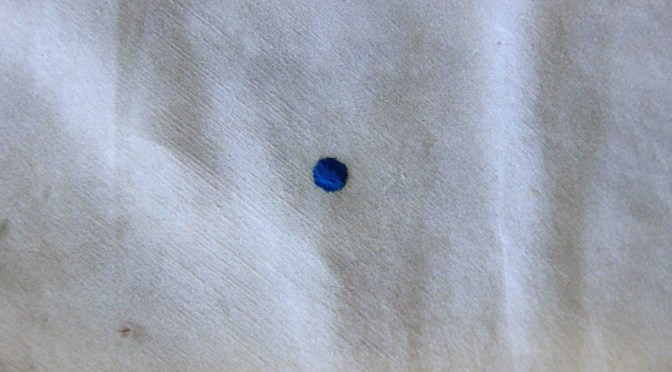
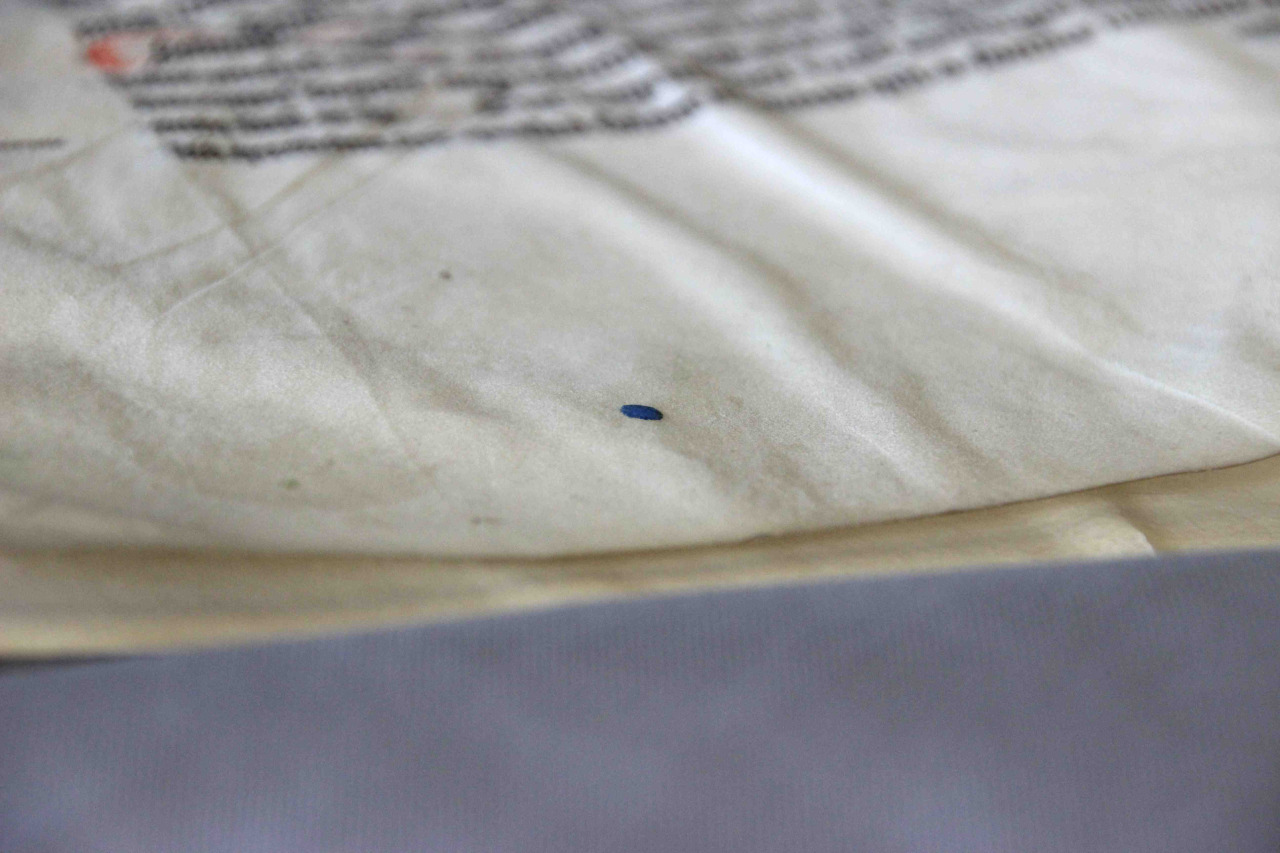
The prettiest “dirt” I encountered – and the only time I found it – is seen in Figs. 6-7. The page in question contains a decorated initial (out of view). After the scribe had copied the page, the decorator would add these with a brush and paint. As he was moving his hand towards to location where he needed to add decoration, in a particularly attractive shade of blue, a drop fell from the brush he was holding. It produced a perfect circle in the lower margin. Interestingly, while such blobs can be removed quite easily when they have dried (with a gentle flick of a knife), this one remained. Not only during the production process of the book, but also throughout the object’s centuries of use. I like to think that the previous users of the book shared my feeling that this blue blob is just the prettiest thing ever.

Leiden, University Library, BPL 64 (13th century) - Photo EK
Fig. 6 – Leiden, University Library, BPL 64 (13th century) – Photo EK
Leiden, University Library, BPL 64 (detail)
Fig. 7 – Leiden, University Library, BPL 64 (detail) – Photo EK

6. Cat paws
Every so often one encounters dirt that is perhaps not particularly insightful as to how a medieval book was used or produced, but it does provide surprising information about the owner, namely that he had a cat (Fig. 8). While this final example brings a “tongue in cheek” conclusion to an otherwise serious post, it does show that books apparently lay open on a desk unattended by the owner. Curiously, it is not the only example of a cat having free access to an open manuscript. Less well known than this inky-cat-paws manuscript (which went viral after my tweet back in 2013; more here) is another book “touched” by a cat, currently kept in Balliol College Oxford (Fig. 9). Here, too, we find evidence of a cat walking over an open book, although this time the paws were dirty, not inky.

Dubrovnic, State Archives (15th century). Pic: Emir O. Filipović
Fig. 8 – Dubrovnic, State Archives (15th century). Pic: Emir O. Filipović – Source
Oxford, Balliol College, MS 192 (15th century)
Fig. 9 – Oxford, Balliol College, MS 192 (15th century), with cat paws – Source

While we are perhaps inclined to regard dirt as an unwanted addition to the medieval book – which is an object that should be spotless, after all – the bits and pieces shown here act as historical clues that shed light on how a book was produced or used. There is an interesting parallel to be drawn with the concept of “damage”. This, too, is often seen as a flaw when encountered in a precious medieval book, while, in fact, it may offer crucial information about how the object was used (see this post). Dirt is an intrinsic part of the historical artefact that is the medieval book and deserves to be studied as such.

Helping Hands on the Medieval Page

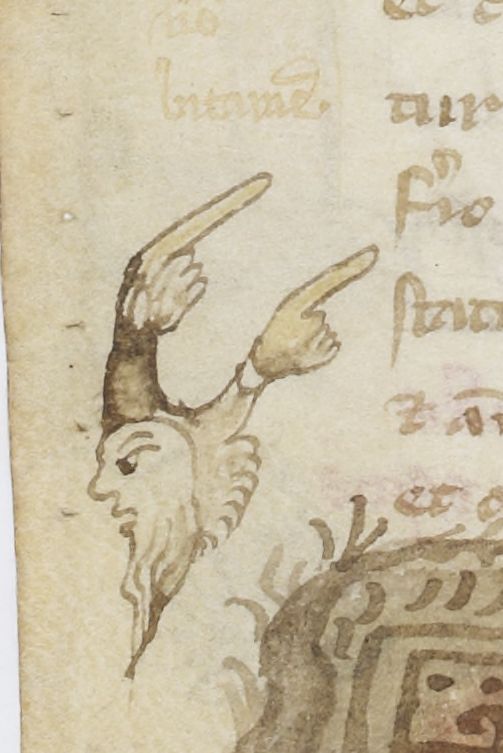
We are taught not to point. Pointing with your finger is rude, even though it is often extremely convenient and efficient. Medieval readers do not seem to have been hindered by this convention: in the margins of books before print one frequently encounters a manicula or “little hand”. While the purpose of these “helping hands” was the same (they were usually put there to highlight an important passage), their appearance varies considerably. This is due to the fact that there was no standard format for the hand – beyond the point that it had to resemble one (Fig. 1).

Leiden, Universiteitsbibliotheek, VLQ MS 99 (13th century)
Fig. 1 – Leiden, Universiteitsbibliotheek, VLQ MS 99 (13th century) – Photo EK

Since the reader was able to shape hand and finger as he or she saw fit, we can sometimes recognise a particular reader within a single manuscript, or even within the books of a library. The charming hands function as a kind of fingerprint of a particular reader, allowing us to assess what he or she found important about a book or a collection of books. This post celebrates the variety encountered in these personal and permanent pointers, from the plain hand to the exotic octopus.

Plain hands
The term “manicula” is somewhat deceptive. Pointing hands are almost never just pointing hands. Usually there are arms attached, which may even be fitted in sleeves. Sometimes these sleeves are elaborate and realistic, with folds and all (Fig. 2). It is an exciting thought that the medieval reader who added this tiny drawing in the margin may simply have looked down and replicated his own arm. If this is true, we may potentially be able to tell something about his status, for example whether he is a monk (wearing a habit) or a private individual. This inference potentially prompts an exciting kind of study, which has never been undertaken. It also makes you wonder what to think of a full figure as seen in Fig. 3. It is tempting to think that we are looking at the reader here – although, realistically, this would probably be pushing it too far.

St Andrews, University Library, Typ NL A85 JT (Antwerp, 1487-1490)
Fig. 2 – St Andrews, University Library, Typ NL A85 JT (Antwerp, 1487-1490) – Source
Bodleian Library, Add. A 15 (14th century)
Fig. 3 – Oxford, Bodleian Library, Add. A 15 (15th century) – Source

Looking at surviving maniculae in medieval books sparks yet another correction: tiny hands are often not really tiny. The one seen in Fig. 1 takes up much of the marginal space. It is a very natural looking hand, with the digits in just the right shape and angle. There is even a nail attached to the finger – the first I have encountered. As you would expect, pointing fingers are attached to both left and right hands. Without having done any conclusive research on this, it appears right hands are more common than left ones.

Elaborate hands
Not all pointing hands look realistic. The one seen in Fig. 2 is representative of a phenomenon that is frequently encountered: the pointing finger is stretched well beyond human proportions. The reason, of course, is that the tip of the finger needs to point out one particular line – otherwise the system would fail. The fingers of a pointing hand can easily be more elaborate. The hand in Fig. 4 is not only unusual in the size of the sleeve and the notes written on it, what really jumps out is the size of the fingers and the way in which they are fanning out. The reader no doubt meant to point out an extensive passage and so more fingers were drafted into service. He did the same thing elsewhere in the manuscript, this time using an octopus with spread-out tentacles (Fig. 5). Another way to point out more than one line is seen in Fig. 6: just use two hands!

Berkeley, Bancroft Library,  BANC MS UCB 085 (14th century)
Fig. 4 – Berkeley, Bancroft Library, BANC MS UCB 085 (14th century) – Source
Berkeley, Bancroft Library,  BANC MS UCB 085 (14th century)
Fig. 5 – Berkeley, Bancroft Library, BANC MS UCB 085 (14th century) – Source
Paris, Bibliothèque nationale de France, lat. MS 4935 (15th century)
Fig. 6 – Paris, BnF, lat. MS 4935 (15th century) – Source

Exotic hands
Then there are the really exotic hands, which are turned into a visual feast. Fig. 7 shows and an arm that was turned into the body of a dragon, while the hands in Fig. 8 (which look like ladies’ gloves) are attached to the wrong location on the human body. These hands are not just meant to point out an important passage, they must also have been intended to bring a smile on the reader’s face.

British Library, Royal MS 12 E.xxv (c. 1300)
Fig. 7 – British Library, Royal MS 12 E.xxv (c. 1300): dragon with hand – Source, via
Paris, Bibliothèque nationale de France, Fr. MS 12584 (13th century)
Fig. 8 – Paris, BnF, Fr. MS 12584 (13th century) – Source

Interestingly, while the dragon could easily have been doodled by the reader himself, the depictions seen in Fig. 8 are carefully designed and painted. These pointing hands – the manuscript contains many of them – were probably done professionally. If this inference is correct, it suggests that the reader asked the artisan to insert them during production. This is interesting because it means that the reader already knew what passages he would wanted to have highlighted. It appears he already knew the text well before he owned a copy.

The range of helping hands is remarkable. There were other, easier ways to mark important passages, such as lines and crosses placed in the margin. However, in some cases readers preferred to have a more pronounced signpost. While a tiny line could be overlooked, the hands – particularly if executed with color – really pulled your attention to the thing that mattered. That particular sentiment lives on in modern times, I recently noticed when stopping at a traffic light for bikers in Leiden, The Netherlands, where I live (Fig. 8). “Dear biker”, the modern (sleeveless) manicula expresses, “push the button if you don’t want to stand here all day.” Now that is helpful.

Traffic light in city of Leiden, The Netherlands - Photo EK
Fig. 8 – Traffic light in city of Leiden, The Netherlands – Photo EK

Cracking Codes in Medieval Books

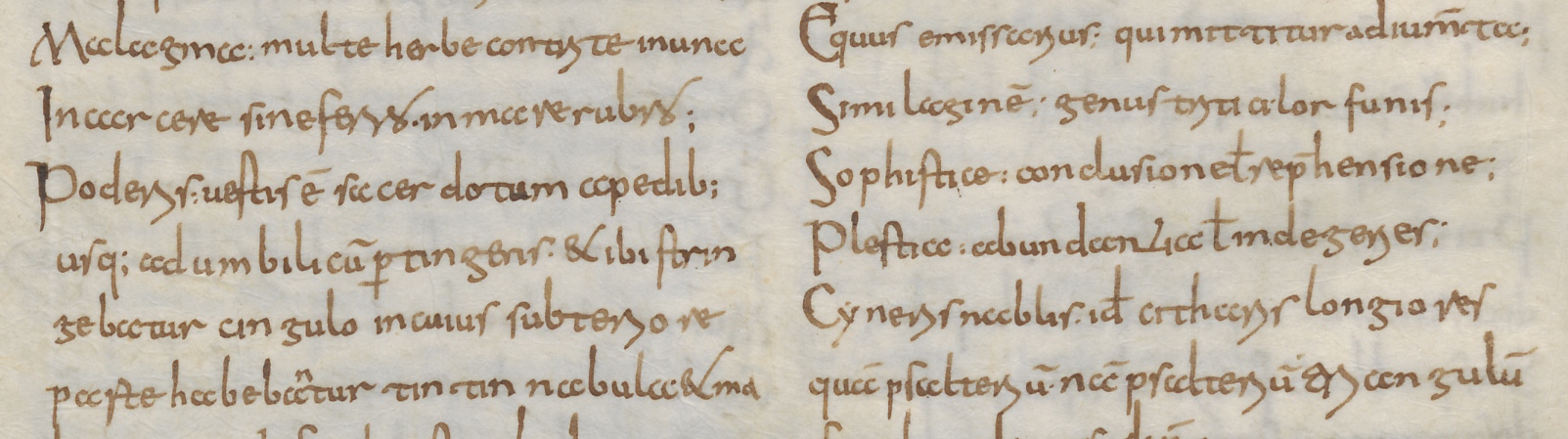
Reading a medieval book may not seem so different from reading a  volume from your own bookshelf: just pick it up, flip to the first page, and start reading. However, apart from the fact that you cannot really hold the average medieval book in your hand – a single volume often weighs as much as a whole pile of today’s books – there is also a problem that occurs when you actually start to read. It turns out you need to decode quite a bit. The first round of decoding happens when your eyes meet the page. The letters on it are shaped very differently from what our brains usually process, so the CPU in our head starts to spin like mad, perhaps even encouraging us to give up. See what happens when you read this snippet from the famous Leiden Glossary (Fig. 1). When you’re done with that, try Thomas Aquinas’ autograph, written in what is appropriately called a ‘littera inintelligibilis’ – indecipherable script (Fig. 2).

Leiden, Universiteitsbibliotheek, VLQ MS 69, fol. 24v, detail
Fig. 1 – Leiden, Universiteitsbibliotheek, VLQ MS 69, fol. 24v, detail (late 8th century) – Source: photo UBL
Vatican Library, Vat. Lat. 9850, autograph Aquinas, 1260-1265
Fig. 2 – Vatican Library, Vat. Lat. 9850, autograph Aquinas, 1260-1265 – Source

The paleographer Lowe defined the first of these as a Pre-caroline Allemannic minuscule, which means it dates from before the establishment of Caroline Minuscule, which came around shortly before c. 800. It is relatively easy to decode the latter with our modern brains. This is because early printers in Italy used Caroline as a model for the Roman typefaces, which ultimately became our Times New Roman. Because we read a version of Caroline on our computer screen every day, we can sort of make sense of a medieval page from the ninth century (Fig. 3).

Leiden, Universiteitsbibliotheek, VLF MS 30, fol. 22v (9th century)
Fig. 3 – Leiden, Universiteitsbibliotheek, VLF MS 30, fol. 22v (9th century) – Source: photo UBL

However, even when you are able to read such easy ‘typefaces’ from before the invention of printing, for example because you happen to be a medieval book historian, there is a second coding problem to overcome, which is much trickier: letters and words are frequently abbreviated with symbols. In fact, sometimes the text of a full page or even an entire book is written in code. Like any cypher, you can only read it if you know the key.

Abbreviations
Decoding abbreviated letters and short common words is not rocket science, nor will it have been for medieval readers. Some of these abbreviations are actually still in use today, like the ampersand in the first line of Fig. 3, which starts with ‘Ignibus & ignis’. The ampersand abbreviates the word et (and), from which it, in fact, evolved (more on the genesis here). Less frequent words could also be abbreviated, but this practice was tricky in that the medieval scribe had to judge whether the book’s reader would understand the abbreviations – otherwise the text could not be decoded. Students in the scholastic environment of the emerging universities were masters in coding and decoding words (Fig. 4).

London, British Library, Arundel MS 383 (1250-1300)
Fig. 4 – London, British Library, Arundel MS 383 (1250-1300) – Source

The students who filled this page with notes abbreviated the words like there was no tomorrow. In fact, in the top segment (in the lighter ink) every single word is shortened with the help of lines, half circles, loops, dots and whatnot. It makes sense that students did this: the remarks are for personal use only, so you could do what you wanted. Moreover, shortening text in this fashion saved time and space. Coded words created room for more coded words.

Tironian notes
In the Middle Ages a peculiar abbreviation language existed, which even an experienced reader at the time was not necessarily able to decipher: Tironian notes. This medieval system of shorthand made use of several thousand symbols, which abbreviated entire words. The language is rooted in Antiquity. The poet Plutarch tells us that Cicero had trained scribes to take down notes at a fast pace, including his servant Tiro – hence the name.

Paris, BnF, lat. MS 11553 (9th century)
Fig. 5 – Paris, BnF, lat. MS 11553 (9th century) – Source

In medieval times Tironian notes were used by scholars trained at the highest level (see this excellent blog post). During the ninth century, the heyday of the ‘coding’ symbols, scholars used them to add comments to a text or to criticise them, much like the students in the university textbook in Fig. 4, and for the same reason: to save space and to increase speed. Sometimes such marginal additions are substantial, like those found in a ninth-century Bible kept in Paris (Fig. 5: right margin and in between lines).

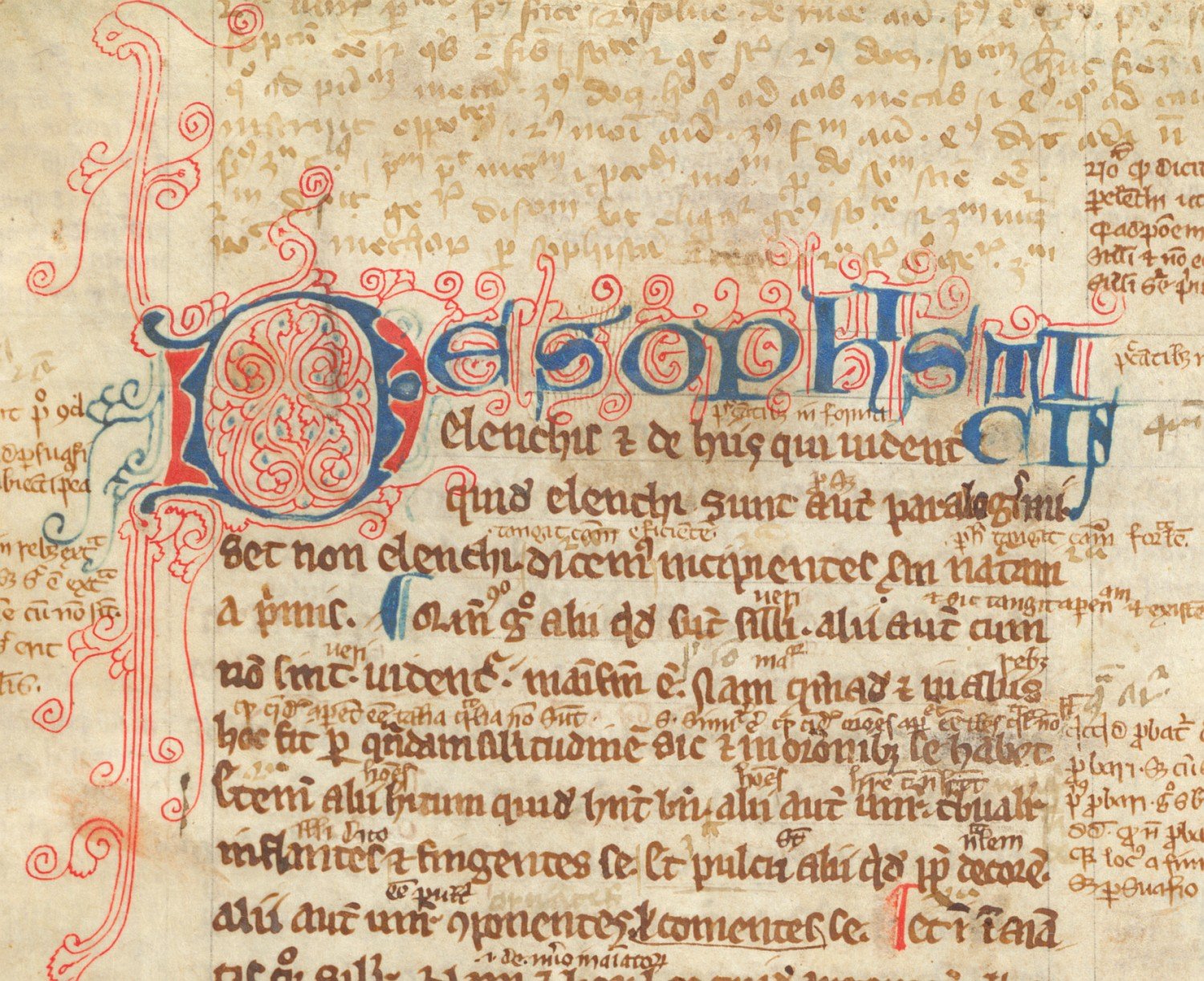
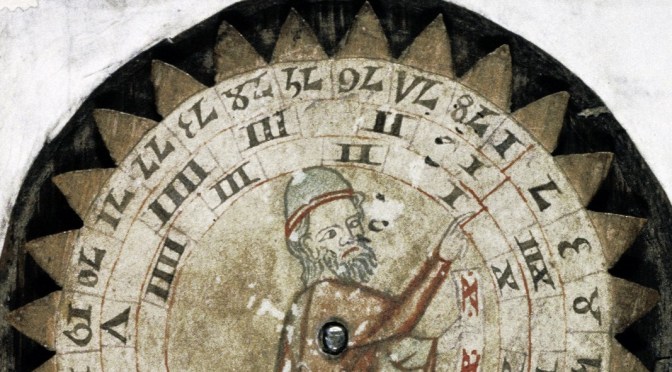
Very rarely does one encounter a full text or manuscript copied out in Tironian notes. The ones I know are all filled with the Psalms, such as Paris, Bibliothèque national de France, lat. MS 190 and lat. MS 13160, both from the ninth century (Fig. 6). What is really great about these coded pages is that the first Tironian note of each chapter is executed in the same style as a regular decorated letter would be: enlarged and painted (see also the detail all the way at the top of this post). The result is a big and beautiful nonsensical shape – unless you know what it means.

Paris, BnF, lat. MS 190 (9th century)
Fig. 6 – Paris, BnF, lat. MS 190 (9th century) – Source

At first sight it seems an odd practice to write an entire book out in code, which could only be deciphered by scholars who had enjoyed the same high level of training as the scribe. However, perhaps these peculiar books were used to train individuals in the notation system? Monks knew the Psalms by heart, making them the perfect tool to learn the strange language of Tiro. The Latin titles would prompt a memorised text, after which perhaps the symbols would fall into place. It is striking, in this light, that the Psalms in MS 190 are preceded by a kind of dictionary to look up the meaning of the symbols – as you would want to do when learning a new language. Several of these explanatory texts survive, including in other Paris manuscripts (such as lat. 7493lat. 8777lat. 8778 and lat. 8780).

Leiden, Universiteitsbibliotheek, VLO MS 84 (9th century)
Fig. 7 – Leiden, Universiteitsbibliotheek, VLO MS 84 (9th century) – Photo EK

A similar explanatory text is found in Leiden (Fig. 7). The first entries on this page read liber, libellus and librarius (book, booklet and librarian). The symbol for the first looks like a bent line with a dot, in the second the dot is replaced by a comma, while the third shows both dot and comma – a librarian, after all, looks after both books and booklets. Then follow related words, such as parchment (pergamena and, less common, pitacium), page and sheets (pagina, carta, cartula). As this segment shows, the text is not so much a dictionary as a collection of thematic word lists.

Uncrackable code
While not everybody in medieval times would be able to read Tironian notes, probably many scholars could decipher it. However, there is a famous coded book that no one could read but its producer: the Voynich manuscript, which is written in an unknown alphabet (Fig. 8). There is considerable discussion about many aspects of this manuscript, including its precise date (see here) and the meaning  of the text it holds. The latter is perhaps the most striking aspect of the code in which the text is written: no one has been able to crack it.

Yale, Beinecke Library, MS 408 (15th century)
Fig. 8 – Yale, Beinecke Library, MS 408 (15th century) – Source

The manuscript has fascinated scholars for a long time. Until 2013, when news outlets claimed the book had a genuine message (see here), it was not even clear if there was meaning in the madness. Finally, in February 2014 an English professor decoded ten words through the proper names of plants (see here). As intriguing as the book is, from a book-historical point of view it is far less interesting than Tironian notes. After all, while the Voynich manuscript appears to be coded in a highly personal way, placing the book in a relatively isolated position, Tironian notes provide an in-depth look into the fascinating world of medieval scholars. To hear their voices, all you need to do is crack the code.

Box It, Bag It, Wrap It: Medieval Books on the Go

Books in use generally reside in our hands or on our desks. This was not very different in medieval times. However, medieval and modern reading culture take different paths when it comes to books that are not in use. While both then and now the objects are commonly shelved after use, medieval readers had additional storing options: slipping the book into a box, bag or wrapper. Unfortunately, few of these exotic – and fascinating – storage devices survive today. However, the ones that do indicate that many were made with a specific purpose in mind, namely transportation. Here are some popular means of packing up your book to go in medieval times, including the precursor of our modern tablet sleeve.

Box it

StGall_360
Fig. 1 – St Gall, Stiftsbibliothek, MS 360 (11th century) – Source

The book box is probably the sturdiest and most effective means to protect your book against the elements and other hostilities on the medieval road. Such boxes were usually made out of wood, to which ornaments, gems and even ivory cuttings were attached, commonly with nails. A particularly well preserved example is seen in Fig. 1. The box contains a famous book of hymns from St Gall, which was designed to be carried in processions both within the monastery and through the nearby city of St Gall. My recent post on “slim” books showed the actual book found inside this box, a narrow object designed to be held in one hand (post here, image here).

Decoration on the outside of the book box not only made the object look pretty, it also gave it prestige. In fact, ivory cuttings and shiny gems reflected the importance the book had within a monastic community or a church. Book boxes actually bear a striking resemblance to medieval reliquaries, shrines or containers made for holding a relic such as the arm of a saint (example here) or a splinter of the holy cross (here). One type of book box in particular matches this profile very well: the Irish cumdach or ‘book shrine’ (Figs. 2-3).

Dublin, Royal, Irish Academy,  D ii 3 (8th/9th century)
Fig. 2- Dublin, Royal, Irish Academy, D ii 3 (8th/9th century) – Source (collections > RIA)
Dublin, Royal, Irish Academy, D ii 3 (8th/9th century)
Fig. 3 – As Fig. 2 but showing the inside, with Stowe Missal visible

The cumdach often held a small manuscript. The Stowe Missal for which the cumdach in Fig. 2 was made, measures only 150×120 mm, which is a little higher than the iPhone 6 (and a little smaller than the iPhone 6 Plus). The book is very snug inside the box (Fig. 3). The small size matches the object’s anticipated use. The Irish cumdachs were often carried around the neck of a monk who would run up and down in front of the troops right before battle. The book became a charm of sorts, which was to bring fortune in battle. It made good sense to store this ‘secret weapon’ in a sturdy box that could withstand all that bouncing around and even a potential blow of a sword.

Stockholm, Royal LIbrary, Karl XII's "fältbibel" (c. 1700)
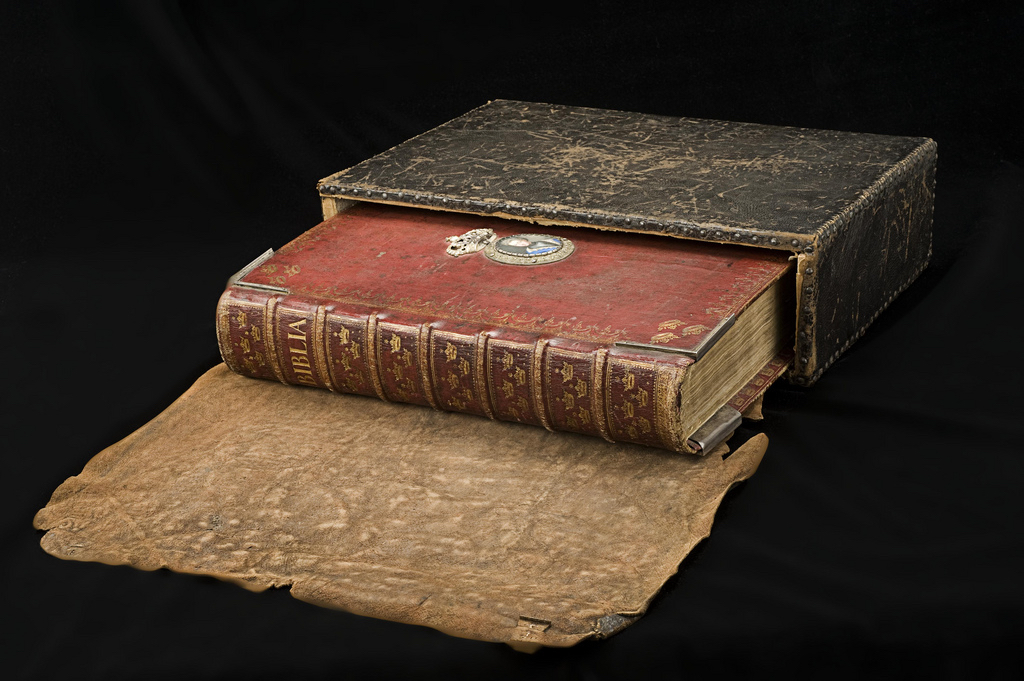
Fig. 4 – Stockholm, Royal LIbrary, Karl XII’s “fältbibel” (c. 1700) – Source

The most famous of these is the sixth-century Cathach of  St Columba, which holds a Psalter from the sixth or seventh century. Curiously, while this cathach (‘battler’) is commonly regarded as an object meant for carrying into battle to ensure victory (source here), it is obviously too big to carry around one’s neck: it measures 270×190 mm and weighs quite a bit. Its user probably ran up and down the battlefield with the book under his arm. Taking your book to battle in a protective box remained popular throughout early-modern history, as shown by the “field Bible” of c. 1700 , which was taken on war campaigns by king Charles II of Sweden (Fig. 4).

Bag it
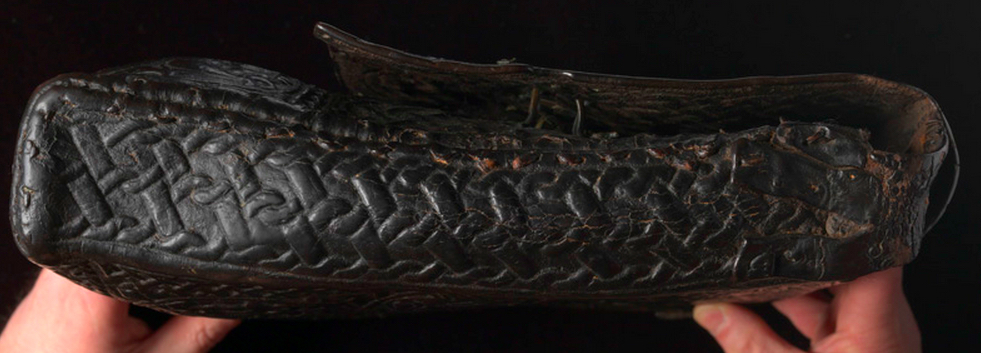
The satchel was another means to carry your book around in the medieval outdoors. They were made of leather and commonly decorated in the manner seen in the famous 9th-century Book of Armagh – which, curiously, has a modern lock (Figs. 5-6).

Dublin, Trinity College, MS 52 (Book of Armagh, 9th century)
Fig. 5 – Dublin, Trinity College, MS 52 (Book of Armagh, satchel, 9th century) – Source
Dublin, Trinity, College, MS 52, satchel side (9th century)
Fig. 6 – Dublin, Trinity, College, MS 52 (Book of Armagh, satchel, 9th century) – Source

Very few such satchels survive but we get an inkling of their use and popularity through medieval texts. A seventh-century tract instructs monks to “Hang your white booksacks on the wall, set your lovely satchels in a straight line” (source). It suggests that each member of this particular community owned a satchel. The same text also explains from what animal the leather came (sheep) and how the skin was turned into a bag: take a square piece of leather, sew it closed except for a single opening, which should be closed by a cover fitted with knobs.

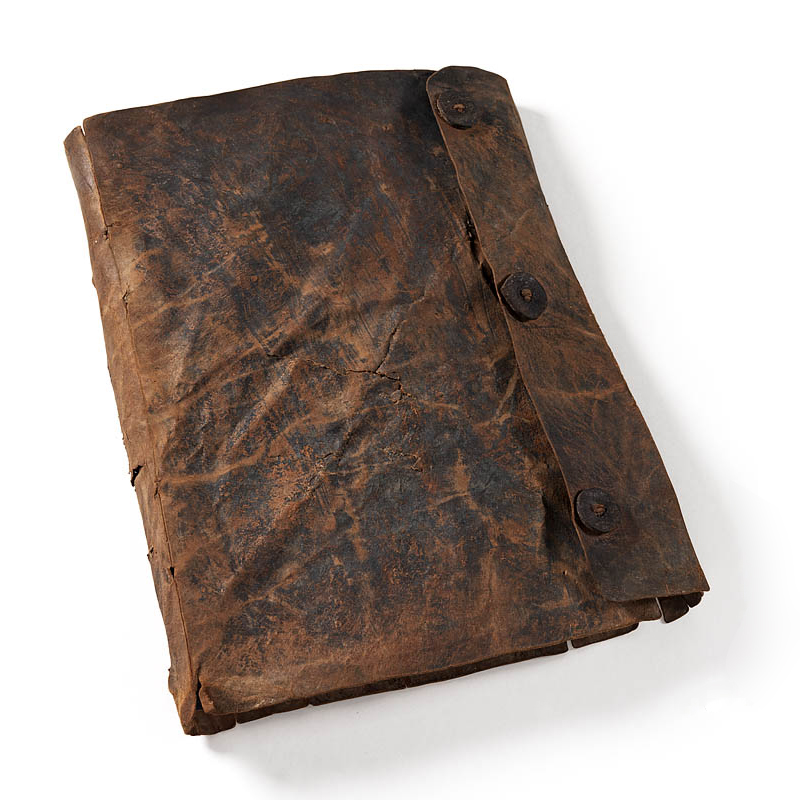
Faddan More Psalter, satchel (9th century)
Fig. 7 – Dublin, National Museum, Faddan More Psalter, satchel (9th century) – Source

In 2006 a particularly old specimen was found in a bog, where it had been resting for 1200 years. Around 800 someone had a portable Psalter made, which came with a leather satchel. Somehow the book fell into the remote bog at Faddan More in north Tipperary, Ireland. Restoration revealed a plain but charming example of an early-medieval book bag (Fig. 7). Because it does not feature a strap, this type of satchel bears a striking resemblance to our modern tablet sleeve: unbutton the flap, slide in your reading device, and be on your merry way.

Like book boxes, satchels had a life far beyond the Middle ages. Fig. 8 shows a 17th-century specimen made of cloth that holds an Arabic devotional book. It belonged to a Turkish soldier captured by Venetian forces in 1668. Like the book box, this charming piece of ‘apparel’ carried a religious text into battle, although in this case the book was likely meant for private reading rather than as an aid to victory.

Stockholm, National Library (17th century)
Fig. 8 – Stockholm, National Library (17th century) – Source

Wrap it
If you wanted to carry your book on your body instead of in a box or bag, for example because you needed to consult the text frequently, the girdle book was your device of choice. The binding of these books came with a wrapper, which kind of flows from the leather of the binding itself. It allowed the user to wrap the manuscript into the leather, which produced a watertight package. A knot was attached to the end of the wrapper. The carrier of the book slipped it under his belt so he could carry the book on his body. Many of these girdle books are small and light objects, which made it easy to dangle the package from your belt. A particularly well preserved specimen in Yale’s Beinecke library shows how well such wrappers protected the book (Figs. 9-10).

Yale, Beinecke Library, MS 84 (15th century)
Fig. 9 – Yale, Beinecke Library, MS 84 (15th century) – Source
Yale, Beinecke Library, MS 84 (15th century)
Fig. 10 – Yale, Beinecke Library, MS 84 (15th century) – Source

This particular book was written in England during the fifteenth century, though the binding may be continental. It measures only 100×80 mm (a little bigger than a credit card) and contains Boethius’ Consolation of Philosophy, a sixth-century text discussing such topics as free will, virtue, and justice. These may not be the usual topics to have ready at hand while walking the streets of a late-medieval city, but someone found such use important enough to have it made portable – and at the ready at all times.

Stockholm, Royal Library
Fig. 11 – Stockholm, Royal Library (16th century) – Source

Other girdle books were objects that could be attached to the owner’s belt with a knot, but their wrappers were not meant to protect the book. The wrapper seen in Fig. 11 leaves much of the book exposed to the elements. This book was made in the very late sixteenth century, when the production of girdle books was in decline. By then its protective function may have have been replaced by fashion: exposure – being seen with a book – may well have been what the owner was after. There was a price to pay, however, as the book is too large and heavy to carry around with convenience. In fact, attaching this object to your belt may have cause unwanted exposure as well: there was a good chance the book’s weight brought down your pants.

Postscript: this older post shows how medieval texts moved through Europe and how you can tell from barely-visible marginal notes.

Medieval Speech Bubbles

This blog frequently highlights parallels between medieval and modern technology and media. My recent posts on SpamGPS and Selfies in medieval times are good examples of that. As odd as this may sound, as a medieval book historian I see such parallels with modern concepts all the time: all you need is a pair of eyes and a little imagination. A few days ago, however, I encountered (and tweeted) a parallel I had never seen before: a drawing with the appearance of a page from a modern comic book (Fig. 1, tweet here).

British Library, Stowe 49 (14th century)
Fig. 1 – British Library, Stowe MS 49, fol. 122r (c. 1300) – Source

The drawing from c. 1300 shows a group of people walking, some of them with a walking stick in their hand. You can almost hear the sing-songs in the background. As it turns out, this merry scene bears more than one parallel to a modern comic book story.

Speech bubbles
According to the description of the British Library we are looking at a group of travellers conversing in English. What the description does not mention, however, is something that is rarely seen in medieval drawings: the different parts of conversation are given the appearance of speech bubbles. That is to say, just like in modern comic books, sentences are visually connected to the individual who utters them, by means of a tiny line (Fig. 2).

British Library, Stowe 49, fol. 122r, detail
Fig. 2 – British Library, Stowe MS 49, fol. 122r, detail

Also in parallel to modern comic books, the story that unfolds is funny and familiar. The art historian Lucy Freeman Sandler has devoted considerable attention to this scene (a transcription and literal translation is found in this publication). Using her work, while rewording her literal translation, the following conversation may be overheard:

The figure on the left starts, with a strange mantra: “They die because of heat, they die because of heat.” Then the two young people on his right speak, probably addressing their father [according to Sandler], who is walking behind them: “Sir, we die of cold!” The father, carrying a heavy toddler, orders them to stop whining: “Behold your little brother in front of us, he is only wearing a hood.” (He is right, because he is otherwise naked.) Then the toddler speaks, uttering universal toddler sounds: “Wa we”. Finally the two children in the back come into play (Fig. 2). “Sir, I am carrying too much weight,” says the one on the left.  The one on the right closes the conversation by comparing his own misery to that of his brother and father, stating “It is not they who carry the heaviest burden.”

The Middle English scene is familiar to many of us. We are shown a family en route to an unknown location (as if it were an alternative version of the Canterbury Tales). The young ones are verbally poking at each other, and complain about the temperature and the weight of their suitcases. It is the medieval version of a modern parent’s nightmare: being on the road with a crying toddler and whiny kids that egg each other on.  “Are we there yet?”

Banderole

Lons Angeles, Getty Museum, MS 66 (
Fig. 3 – Los Angeles, Getty Museum, MS 66 – Source

Books before print had another way to make a silent figure on the page speak: the banderole. This clever device gave the decorator the ability to make someone deliver a short statement. Short, because it had to fit on a tiny scroll (see a collection of them here and in this blog post). In Fig. 3, for example, we see a fool repeat the words whispered in his ear by the devil: “There is no God” (Non est deus). The speaker holds the tip of the scroll in his hand, so as to claim the words as his own. It also happened that the speaker was pointing at the banderol, often touching it with his finger.

Schøyen Collection MS 33 (14th century)
Fig. 4 – Schoyen Collection MS 33 (14th century) – Source

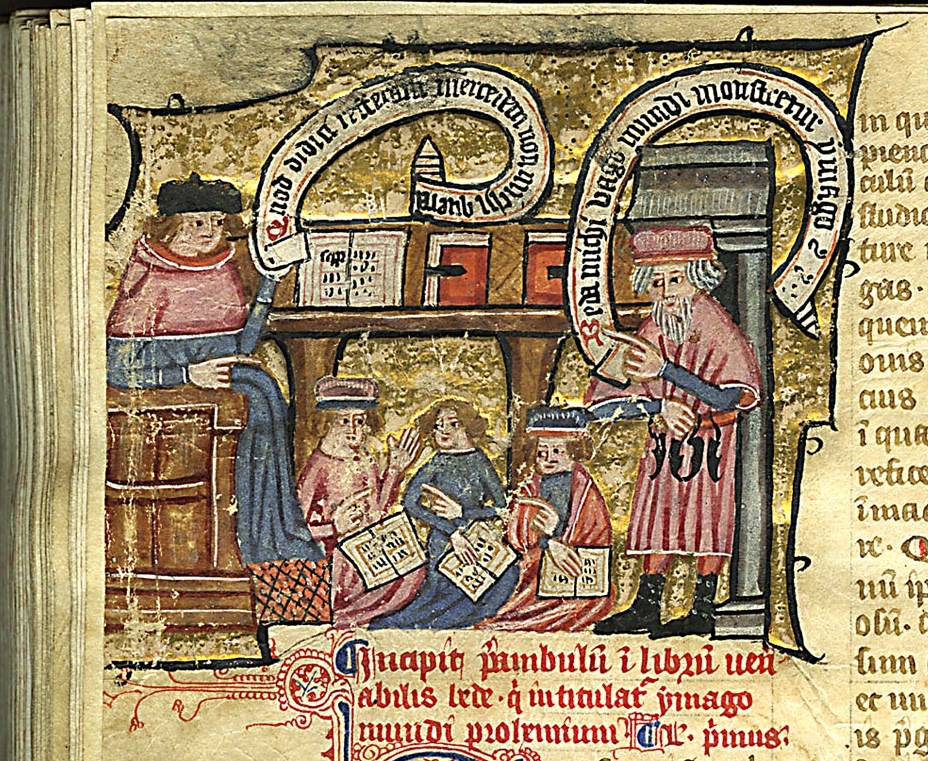
Such points of contact (holding the scroll or touching it) were particularly important when an image presented more than one speaking person. It allowed the viewer to identify who was saying what. Fig. 4 shows a classroom where two teachers appear to be in a lively debate. One is holding the scroll, the other is pointing at it, each firmly securing the text to their own person.

Interesting in light of the comic book parallel is that the banderole was not always held in or close to the speaker’s hand: it could also flow from his or her mouth. While such cases are less common, they have a strikingly modern appearance because of the banderole’s white background, which creates the illusion of a real text bubble (Fig. 5).

Paris, BnF, lat. 11978 (15th century)
Fig. 5 – Paris, BnF, lat. 11978 (15th century) – Source, found via
Frankfurt, Staatsbibliothek Ms. barth. 42
Fig. 6 – Frankfurt, Staatsbibliothek, Ms. barth. 42 (12th century)

Not all banderoles present such a “live” text. Some label a scene, while others clarify the identity of a person. For example, the banderole in Fig. 6 introduces the twelfth-century illuminator Guda, who decorated the book in question, but it does not present direct speech (more about the image in this post). Instead, it is the medieval equivalent of tagging a person in an image.

No bubbles
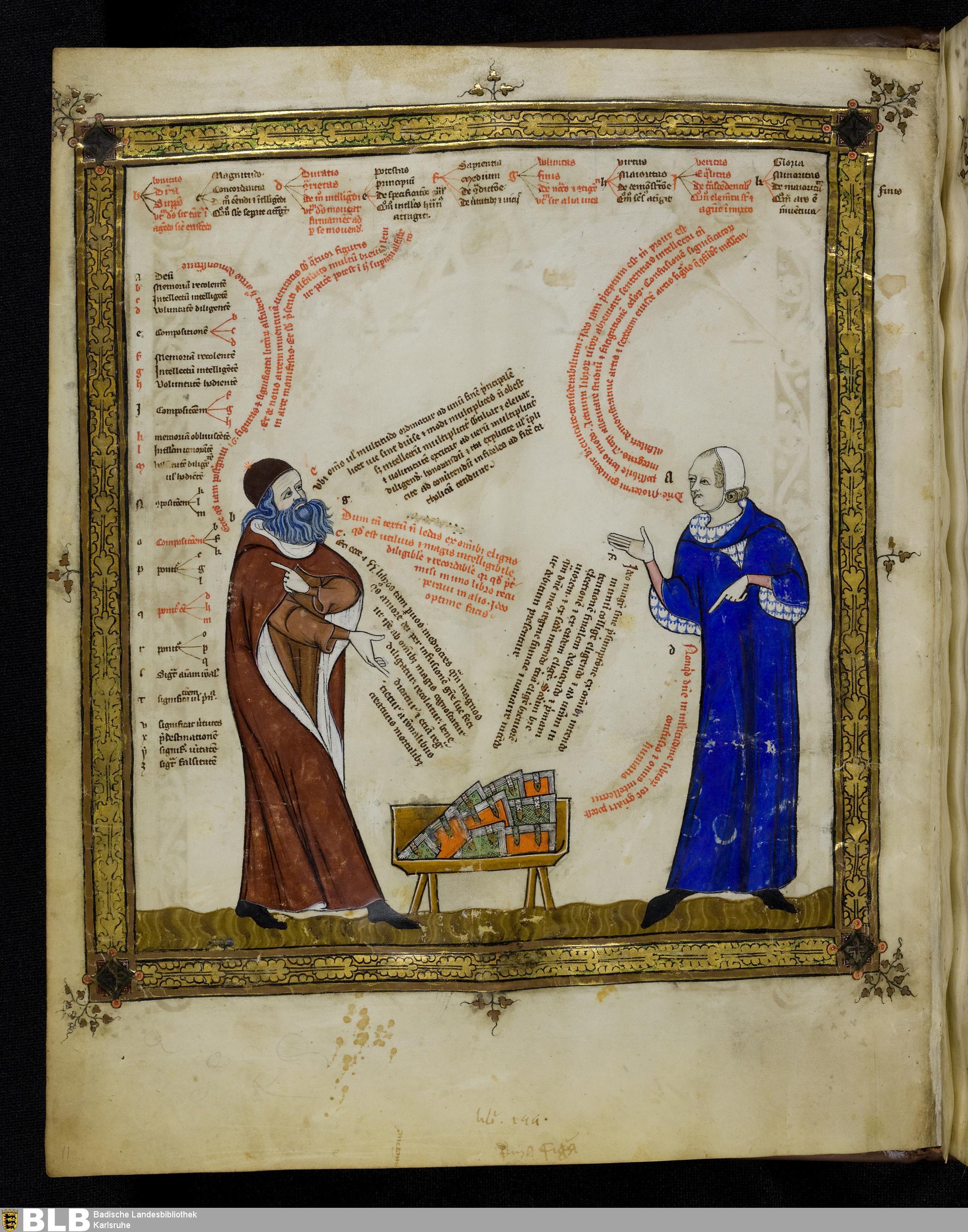
Then there are, finally, manuscripts where direct speech is written in mid air, unsupported by a banderole or a bubble. In order to relate the uttered text to a given person, the scribe wrote the lines in such a way that they appeared to flow from the speaker’s mouth. The result are wavy lines of text that dance across the page. A great example is seen in Fig. 7. This miniature is part of a cycle on the life and work of the scholar Raymond Lull (d. 1316). Here he is shown discussing with Thomas Méysier, his student and disciple. The images in the cycle were made under personal supervision of Thomas, who also compiled the contents of the manuscript, which presents a compilation of Lull’s work called the Electorium parvum sue breviculum (more here).

Karlsruhe, Badische LandesBibliothek, St Peter Perg. 92 (14th century)
Fig. 7 – Karlsruhe, Badische LandesBibliothek, St Peter Perg. 92 (14th century) – Source

Although serious in subject matter, the conversation between the master and the student has a funny, almost grotesque appearance. Over a big and authoritative pile of books we see the scholars engaged in a lively discussion. Arguments fly across the page. It looks like the scribe is trying to help the viewer keep track of the discussion through the use of different colours (red and black). Also, the scribe presents the conversation in such a way that each component begins with a line that sticks out slightly. Cleverly, the extended tip is found next to the speaker’s mouth, leaving no doubt as to who is saying what. No bubble required.

Acknowledgments – I wish to thank Thijs Porck (Leiden) for his help with the Middle English translation of the scene in Fig. 1. My PhD student Jenneka Janzen (Leiden) introduced me to the Karlsruhe manuscript in Fig. 7.

Medieval Apps

How about this for a truism: a book is a book, and something that is not a book is not a book. This post will knock your socks off if you are inclined to affirm this statement, because in medieval times a book could be so much more than that. As it turns out, tools were sometimes attached to manuscripts, such as a disk, dial or knob, or even a complete scientific instrument. Such ‘add-ons’ were usually mounted onto the page, extending the book’s primary function as an object that one reads, turning it into a piece of hardware.

Adding such tools was an invasive procedure that involved hacking into the wooden binding or cutting holes in pages. In spite of this, they were quite popular in the later Middle Ages, especially during the 15th century. This shows that they served a real purpose, adding value to the book’s contents: some clarified the text’s meaning, while others functioned as a calculator or, astonishingly, allowed the reader to tell time. These fascinating add-ons  – which are really not that different from the apps on our smartphones – turned a static handwritten book into an interactive object.

The Volvelle

British Library, Egerton MS 848 (15th century)
Fig. 1 – British Library, Egerton MS 848 (15th century) – Source

A volvelle is an instrument that consists of one or more rotating disks mounted on the page. Volvelles allowed the reader to make a variety of complex calculations, such as the position of the sun and the moon, or the precise date of Easter – which was, like the volvelle, a moving feast. The one seen in Fig. 1 contains no less than three revolving disks, which are pinned to the page in a central point: two show the cycle of sun and moon (note the charming depictions at their pointers), while a third presents the Zodiac.

In spite of its simplicity, the device provides a surprising wealth of data, which could be read if one knew how to interpret the dials. However, volvelles were not always crude instruments providing dry data. Some are actually a pleasure to look at (Fig. 2). Others added an entertaining touch to the moving parts. The one in Fig. 3, for example, calculates the date of Easter, a popular application of the volvelle, but in this case the answer is pointed out by a spinning lady.

Heidelberg, Universitätsbibliothek, Cod. Pal .833 Ger. (early 16th century)
Fig. 2 – Heidelberg, Universitätsbibliothek, Cod. Pal .833 Ger. (early 16th century) – Source, more here
British Library, Harley MS 941 (15th century)
Fig.3 – British Library, Harley MS 941 (15th century) – Source

The oldest volvelles are connected to the scientific explorations of Raymond Lull, a thirteenth-century scholar, who introduced the clever device from Arabic scholarly culture. It explains why the earliest volvelles date from the 13th century (there are no older manuscripts that hold them, as far as I am aware), but also why the oldest ones are found in books holding works by Raymond Lull. These oldest specimens are less sophisticated: they have a limited number of disks and present less data on and around the dials (see a Lull specimen from the early 14th century here).

Maastricht, Regionaal Historisch Centrum Limburg (15th century)
Fig. 4 – Maastricht, Regionaal Historisch Centrum Limburg (15th century) – Photo EK, source

Such crude medieval computers could make a page very bulky. It is surprising, however, how much volume a volvelle could take up without compromising how well the book could be handled.The one I encountered in an archive some time ago even makes use of pieces of wood, giving it the appearance of a real instrument, but also adding a certain clunkiness (Fig. 4).

Cogwheel

Oxford, Bodleian Library, Digby MS 46 (14th century)
Fig. 5 – Oxford, Bodleian Library, Digby MS 46 (14th century) – Source

Volvelles are not the only instruments mounted onto the medieval book. Fig. 5 shows a page from a manuscript containing various texts about fortune telling. The page holds a text on Geomancy, which is a method of divination that allowed someone to calculate one’s ‘key number’. Random rows of numbers were drawn up  and marked down (as seen on the page), after which they were connected by lines. The number you ultimately ended up with was then looked up in a table with lunar and solar information, which was also included in the manuscript (image here).

Oxford, Bodleian Library, Digby MS 46 (15th century)
Fig. 6 – Oxford, Bodleian Library, Digby MS 46 (14th century) – Source

There was another method to calculate this number: by turning a wheel (information here). It is here that the Oxford manuscript becomes relevant for us. Remarkably, the user of the book carved a hollow space into the wooden front board of the binding and fitted a pair of cogwheels into it (Fig. 6). Turning these produced the number that could subsequently be looked up in the table.

The last word: sundial

Oxford, Bodleian Library, Brox._46.10 (17th century)
Fig. 7 – Oxford, Bodleian Library, Brox._46.10 (17th century) – Source

The last example of an instrument that was added to a book also has to do with the sun. Like an iPad, the book in Fig. 7 has a smart cover. The front of the sheepskin bookbinding is not filled with blind-stamped decoration, as was often the case, but rather a sundial was pasted on it. The reader could put the book in the sun and place a stylus on the cover, which would reveal what time it was. While it may not have been a very practical clock, the cover reveals that it was likely used to this end: the ‘footprints’ of the stylus are still visible (note the small circle and the black stain near the letters IHS, at the bottom). Moreover, the severity of the stain suggests the book was frequently used to tell time.

Just like our modern smartphones, the medieval book could be a versatile tool that combined contents with an untold number of applications – giving the scriptorium the feel of an App Store.

Books on a Diet

We’re all familiar with that most popular of New Year’s resolutions – and the one that is broken most frequently afterwards. While many oversized medieval books look like they enjoyed life to the max, this post is devoted to a relatively rare kind of manuscript that is much slimmer than what you would expect (Fig. 1). “Expect”, because the relative proportions of manuscripts – the width in relation to the height – form a surprisingly stable feature in medieval book production. In fact, the vast majority of surviving manuscripts have the same relative proportions as our modern paper: their width is around 70% of their height.

British Library, Harley MS 5431 (10th century)
Fig. 1 – British Library, Harley MS 5431, 230×85 mm  (10th century) – Source

This stability ought to surprise you. While readers of printed books had little choice as to the physical appearance of the object they read, owners of manuscripts handled a book that was made especially for them. Consequently, they would commonly have specified what it should look like. You would think that medieval readers might go overboard and abuse this freedom of choice, ordering polka-dotted books with pink letters written upside down on triangle-shaped pages. The opposite turns out to be true. Book owners before print are predictable in that they mostly opted for regular features: their choices are typical, as if they conform to unwritten rules.

This striking act of conformation results from what is a main driving force behind the chosen physical features: the anticipated use of the object. For example, if you anticipated that you would scribble an excessive amount of notes in your book, you would specify to the scribe to extend the size of the margins. And if you knew that you would take a book with you when you left the house, it would make sense to have that copy produced in a suitably small format. This strong link between form and function is good news for us: we may infer that narrow books– sometimes called “holsterbooks” – were put on their diet for good reason.

Ivory Decoration

Frankfurt am Main, Goethe Universität, Barth MS 181 (14th century)
Fig. 2 – Frankfurt, Goethe Universität, Barth MS 181, 402×250 mm (14th century) – Source

One reason to slim books down had to do with their binding; or more precisely, with its decoration. The most prestigious decorative element of a medieval binding was ivory plaques, slabs of tusk on to which elaborate scenes were cut (Fig. 2). They were attached to both the front and back of the manuscript, usually embedded in the wood of the boards. Book projects that involved this costly decoration commonly produced manuscripts that were much narrower (or taller) than the norm. The plaques themselves had to be narrow given the limited width of the tusk. Interestingly, however, manuscript makers appear to have preferred the book to be equally narrow. This was probably done for visual reasons: it looks better when the relative proportions of book and decoration are in sync. Moreover, keeping the book slim meant that more visible space was covered with ivory.

St Gall, Stiftsbibliothek, MS 53 (c. 895)
Fig. 3 – St Gall, Stiftsbibliothek, MS 53, 395×323 mm (c. 895) – Source

This tendency to keep a book narrow when ivory decoration was added is mentioned in a remarkable account by the historian Ekkehart of St Gall (d. 1022). Referring to what is now St Gall, Stiftsbibliothek, MS 53 (Fig. 3) he states that this manuscript was made tall and narrow for good reason. Among the abbey’s treasures, he reports in his chronicle, were two ivory plaques. They once belonged to emperor Charlemagne (d. 814), who used them as a wax tablet, which he kept next to his bed. When it was decided in St Gall that the plaques would be used to decorate the bookbinding of a newly produced Gospel Book, the scribe was asked to design the book in such a way “that it matched the shape of the ivory”. Interestingly, Ekkehart noticed that it was narrower than usual, because he addresses MS 53 as “our tall Gospel Book”.

Books for soloists

St Gall, Stiftsbibliothek, MS 360 (11th century)
Fig. 4 – St Gall, Stiftsbibliothek, MS 360, 255×80 mm (12th century) – Source

A second reason to produce a slim book in medieval times is pragmatic rather than artistic. When one examines what these oddly tall manuscripts contain, as I did in a journal article published in 2012 (details here), it turns out that a fair number consist of texts that were sung by soloists during the church service. Take the Cantatorium and the Troper, two frequently-used musical books. When one limits the view to the period before 1200, as I usually do in my scholarly work, it turns out that all surviving copies are formatted in the slim format discussed here. Another example is the famous St Gall Hymnal, which is not just very narrow, but also very thin (Fig. 4). It is not given a proper binding, but it is stored in a book box, not many of which survive from medieval times.

The reason for these musical books to be designed so awkwardly (in that they break with the norms of medieval book production) is related to how they were used: handheld – literally, as in “while held in one hand”. As I proposed in the article previously mentioned, the effect of the narrow shape was that the weight of the book rested on the palm when it lay open in your hand. This meant that the soloist could easily hold it up for a long period of time. Regularly shaped books, by contrast, executed considerable pressure on the fingertips and the thumb when you held them in one hand. This is not surprising, of course, because they were not designed for holding: they were supposed to rest on a desk or podium while in use. The thinness of the musical books was helpful in this respect, because it greatly reduced their weight, as did leaving off a binding (think St Gall Hymnal). As with the shift in the pressure points, the weight loss helped the reader holding up the book for a long time.

A long tradition

Oxford, Bodleian Library, Douce MS 228 (15th century)
Fig. 5 – Oxford, Bodleian Library, Douce MS 228 (15th century) – Source

While the examples so far focused on the period before 1200, the practice of making slim books is thriving in the later medieval period as well. In the fifteenth century, for example, we see municipal clerks make narrow literary manuscripts, probably conforming to chancery practices. Moreover, there appears to be a real tradition of slender paper books in Middle English literary culture. The Romance of Richard Coeur de Lion in Douce 228, for example, is the slimmest manuscript I know (Fig. 5). It has been argued (here) that this particular manuscript was made for minstrels, in other words that the object was used hand-held. Having read this post, you now know that this makes perfect sense.

Across the board, ivory decoration and handheld use are two significant factors in this long tradition of making “slim” books. When faced with a slender book, we can therefore speculate: was its binding perhaps originally fitted with ivory decoration? Or, if this seems unlikely because the parchment and handwriting suggests a cheap production, perhaps it was made for handheld use? As in modern times, diets and weight loss relating to the medieval book speak to deeper motivations.

Erik Kwakkel blogging about medieval manuscripts