Medieval Book Carousels

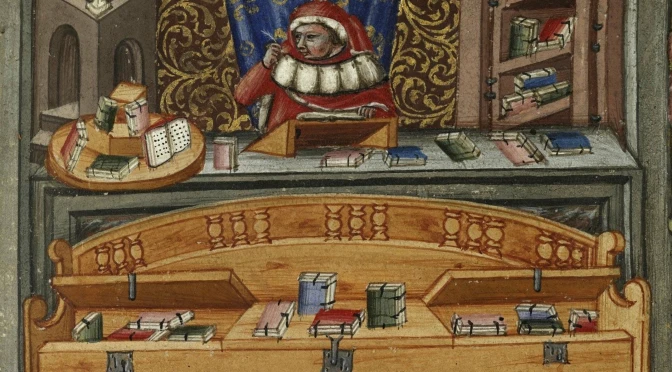
Medieval readers, especially studious ones, must have cursed their desks from time to time. It is not easy to manage desk space when working with often large and clunky medieval books. Scribes and translators developed work-arounds for these space issues, as I have shown in a blog post on medieval desktops. Scribes would place two desk surfaces stacked vertically, one for the book that was copied from, the other for the copy (image here). In contrast, translators would sometimes position two surfaces next to one another, one presumably for the original text, the other for the translation (see the striking images here and here). Readers, however, faced bigger challenges, since many needed more than two books open at the same time, which produced clutter and frantic searches for particular information. Figure 1 shows the French author Christine de Pisan, who is often shown while working in her study (here is an interesting article on the iconography), sitting behind a desk cluttered by books.

Brussels, Bibliothèque royale, Ms. 9009-11
Figure 1. The author Christine de Pisan shown as a reader, book clutter in fronts of her (Brussels, Koninklijke Bibliotheek, 9009-11, 15th century). Source

Near the end of the Middle Ages a device came into service that helped avid readers like Christine: the book carousel or book wheel. When precisely this device became available to medieval readers is hard to deduce, but the oldest specimens I was able to find date from the fourteenth century. While being careful of the fact that medieval images may not necessarily be a truthful depiction of reality, it appears that during this early period there are two clearly distinguishable designs available. The difference lies in the number of shelves the device was fitted with, and thus in the carousel’s capacity.

Plain design

The book carousel enabled readers to have multiple books at hand, including copies that were opened to a relevant page. Among the earliest depictions are carousels shown with a single deck, providing room for no more than four to six tomes (although those with room for only two books also existed, as seen here). Early depictions of this “plain” model are seen in Figure 2 (from 1383) and Figure 3 (from c. 1400). These book wheels share some striking features. One is that the carousel stands on top of the desk, usually at the far end, where it is out of the way. This is most clearly observed in the depiction of a writing Cicero in the Bodleian Library manuscript (Figure 2). Here the carousel is placed in arm’s reach and contains various open books: the author merely has to turn the platform – carefully! – to consult them. Additional books are present in a book cupboard nearby. These would presumably be placed on the wheel when they were needed.

Oxford_Bodleian_Canon._Class. _Lat257
Figure 2. Cicero composing a work sitting at this desk (Oxford, Bodleian Library, Canon. Class. Lat. 257, dated 1383). Source

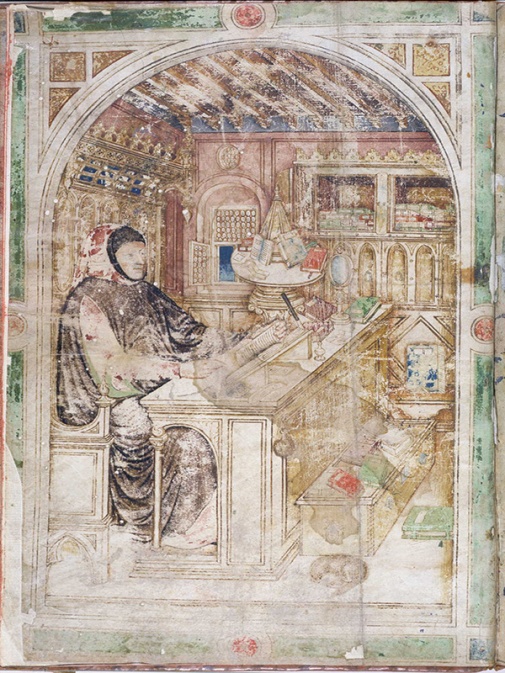
A similar scene is observed in Figure 3, which is found in a copy of Petrarch’s De viris illustribus kept in the University Library in Darmstadt. Here, too, an author is seen at work with a book wheel nearby. This carousel is placed on the desk, although the image shows this less clearly. Here the author is reading, not writing: Petrarch uses both hands to thumb through the book as if looking for certain information. More sources are nearby, placed on the book wheel, which can be consulted simply by reaching over. As in Figure 2, an open book is present on the platform; additionally, a red copy with the clasps unhooked lies at the ready. However, the platform also holds a roll, by the looks of it, as well as loose pieces of paper. This carousel is clearly in heavy use!
Darmstadt_UB_101
Figure 3. Petrarch sitting at a desk with a book carousel placed nearby (Darmstadt, Universität- und Landesbibliothek, MS 101, datable to c. 1400). Source

The images shown so far share two striking features: the book carousel appears to consist of a single platform and the device was small enough to place on top of one’s desk. (Curiously, some carousels were designed with an arm, enabling the user to “swing” the platform closer, as this example shows.) This relatively plain design continued until the end of the medieval period, and even beyond. Figure 4 shows a woodcut from a late-fifteenth-century incunabulum (an early printed book) containing a bible with commentary (here is another example from an incunabulum). Jerome, that revered bible translator, is shown sitting behind a single-platform book wheel consulting various source texts. While this scene is very appropriate given that the Church Father is known to have consulted a great deal of sources for the production of his Vulgate Bible, including Hebrew manuscripts, it clearly concerns medievalization of an ancient scene.

Paris_Mazarine_1339_A_f._014
Figure 4. St Jerome shown as bible translator, while consulting sources on book wheel (Paris, Bibliothèque Mazarine, 1339, A f. 014, late 15th century). Source

More sophisticated designs

There were also more sophisticated carousels available to the medieval reader: some book wheels were fitted with two rotating platforms. This seems a sensible step-up given the limited capacity that came with a single platform – note that the individuals in Figures 2-4 all have books nearby that do not fit on their carousel. Among the surviving depictions of this “double-decker” design are two from the fourteenth century (Figures 5-6). It shows that the one and two-deck designs were in use in the same century, which indicates that readers likely preferred one or the other. In other words, we do not seem to be dealing with a chronological development.

Cambrai_BM_620
Figure 5. Scribe (likely the author Johannes Andreae) at work, surrounded by books (Cambrai, Bibliothèque municipale, 620 (572)), c. 1320-1340. Source
Oxford_Bodleian_E_Mus._65
Figure 6. One of the authors of Le Roman de la Rose, Guillaume de Lorris or Jean de Meun, shown with book wheel (Oxford, Bodleian Library, MS e Mus. 65, datable to c. 1390). Source

Both individuals seen in Figures 5-6 are scribes. The first in particular is very engaged with books, which are shown all around him. Not only is his desk fitted with a two-tiered book carousel, there is also a book case present behind him (note the handy fold-away doors), as well as a wooden bench that doubles as book storage. This “book bench” is fitted with locks, so that its precious contents were hidden from thieves.

Even more sophisticated designs appeared just beyond the Middle Ages. Surviving from the sixteenth and seventeenth centuries are both depictions and actual specimens of book carousels that were not fitted with a horizontally turning platform, but that moved vertically. Carousels with this orientation can be fitted with a relatively high number of shelves, perhaps as many as eight or ten. In order for the books to not fall off, it was crucial that the shelves remained level as they were turning. The most famous of these is the book wheel shown in The Diverse and Artifactitious Machines of Captain Agostino Ramelli from 1588 (Figure 7). The engraving includes the complex mechanism that held the books level.

The Diverse and Artifactitious Machines of Captain Agostino Ramelli”, 1588.
Figure 7. A scholar behind a vertical book wheel, as shown in Le diverse et artificiose machine del Capitano Agostino Ramelli, 1588, fig. CLXXXVIII (Beinecke Rare Book and Manuscript Library, Yale University, Eliz+47). Source
Leiden_Bibliotheca_Thysiana
Figure 8. Book wheel in Bibliotheca Thysiana, Leiden (mid 17th century). Source: photo by the author

Early-modern readers also could opt to purchase (have built, presumably) a less elaborate carousel with a vertical orientation, one with a modest number of shelves, each of which fitting one or two books. The one in the Bibliotheca Thysiana in Leiden contains only four shelves (Figure 8). Its user, Johannes Thysius (d. 1653), could consult up to eight books at the same time while sitting or standing behind the machine. The mechanism that held the books level is hidden inside the sides of the carousel. Even though you’d expect the books to remain on the shelves, it is quite a sensation to see the shelves remain dead level as you turn the carousel:


Larger carousels than the ones shown here do not seem to have been around in the medieval or early-modern period. There were ways to expand the device’s capacity, however, for example by adding a stationary shelf at the foot of the carousel, or even placing the book wheel on top of a small book cupboard (here is an example). Cases like this show that book carousels may have doubled as book cases. After all, private individuals in the medieval period did not usually own a large library. The modest number of books they owned would normally fit on a book wheel with a horizontal orientation. In other words, in addition to being a handy device for studying or reading multiple books at the same time, book carousels were also most useful storage devices, keeping books safe and off the ground.
Doodles in Medieval Manuscripts

Doodling is something we all do, from time to time, often without realising. Listening to someone on the phone or perhaps attending a meeting (or class), we scribble, rather haphazardly and spontaneously, squiggly lines, random words, and mini drawings. The practice is quite old. Doodled squiggly lines and mini drawings are encountered frequently in medieval books, mostly in the margins or on flyleaves. The one in Figure 1 was added to the lower margin of a manuscript with Juvenal’s Satires. Its style resembles our modern stick figures and it may just be the artistic creation of a child.

Carpentras_BM_368_f64v
Figure 1. Doodle in the lower margin of a medieval page (Carpentras, Bibliothèque municipale, 368 (15th century). Source

In spite of the parallel with modern times, the rationale behind doodling in manuscripts is usually very different. Exceptions such as the one in Figure 1 aside, the medieval practice of doodling has little to do with boredom or absent-minded pen movements. They are calculated products of the pen, executed with a particular goal in mind.

Why Pen Trials?

The answer to this question lies in the two tools wielded by medieval scribes more than any other instrument. In miniatures scribes are often shown with a pen in one hand and a knife in the other, such as the hermit seen copying text from an exemplar in Figure 2. (Note, incidentally, the handy paraphernalia he has at his disposal, like the slider that helped him keep track of the line he was supposed to copy.) Here we see the scribe using the tip of the knife to keep the parchment in place: using his hands would release oily grease onto the writing surface, which would subsequently prevent the ink from sticking properly.

Royal 14 E III f.6v
Figure 2. Scribe at work, pen and knife in hand (London, British Library, Royal 14 E.iii, 14th century). Source

An equally important use of the knife, however, was to adjust the nib; and it is here that the origins of the pen trial – and the doodle – are found. After some time, a few hours perhaps, the nib became dull and it needed to be cut again in order to produce crisp letters. After trimming the nib, the scribe tested his pen to check that it had the right width and to make sure there would be no streaks of white visible within the strokes of the letters. For this testing process he turned to an empty piece of paper or parchment and scribbled down some squiggly lines or short words. The process was quick and routine among scribes across medieval Europe (Figure 3).

BPL 111 I
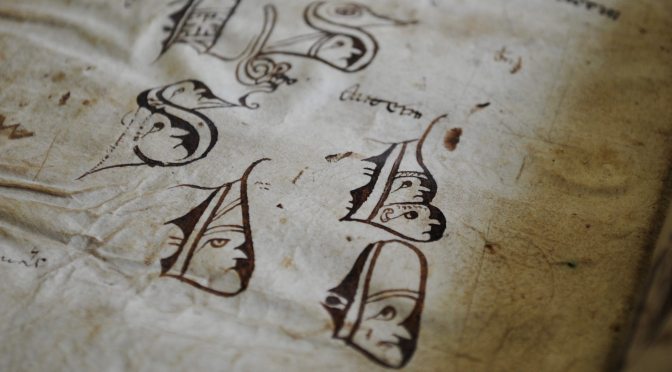
Figure 3. Two flyleaves filled with pen trials (Leiden, Universiteitsbibliotheek, BPL 111-I, 13th-15th centuries). Photo by the author

Palette

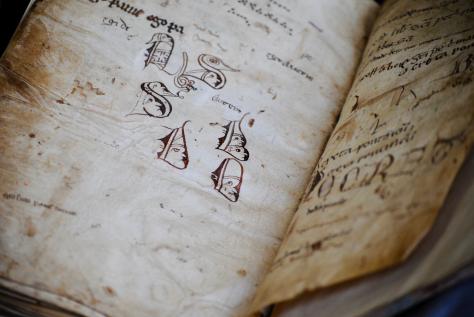
Pen trials, which are most often encountered on flyleaves in the back of manuscripts, can be quite appealing. As it happened, scribes did not just write down squiggly lines or words when testing their pens, but they even produced modest works of art. In Leiden University Library some great “artistic” specimens are encountered. In the back of BPL 111-I, for example, we find a collection of large initial letters with faces inside them (Figure 3). It includes a letter B with two monks (note the tonsures), a D with a stern-looking lady wearing a pointy hat, a bearded person in a letter S, and a duck containing a long-nosed man. This page and the facing one are filled with dozens of pen trials. The shapes of the letters and the ink colour suggests that the doodles on these pages were produced by a limited number of individuals, perhaps two or three, which is in line with what we commonly see on flyleaves that contain pen trials.

The two pages in the back of BPL 111-I are also in line with broader European traditions regarding the kind of tests they contain. We encounter single letters and words, as well as nonsensical phrases (“e,” “egi de e,” “ego panne,” “autem”). Another popular theme is also found in Figure 3: musical notation (somewhat out of focus near the top of the picture). The square notes of the Middle Ages were perfect for testing the nib, because they naturally showed how wide it was, while the short square shape also invited the scribe to execute a series of quick test strokes. Common also are the little specks visible in Figure 3: you can vaguely see them in the white zone below the initial letters. These result from tapping the quill on the parchment, probably in an attempt to adjust the nib by “tapping” it into shape.

Cambridge_Parker_LIbrary_223_p338
Figure 4. Pen trials by a high volume of individuals (Cambridge, Parker Library, MS 223, p. 338, twelfth century). Source

Scriptorium

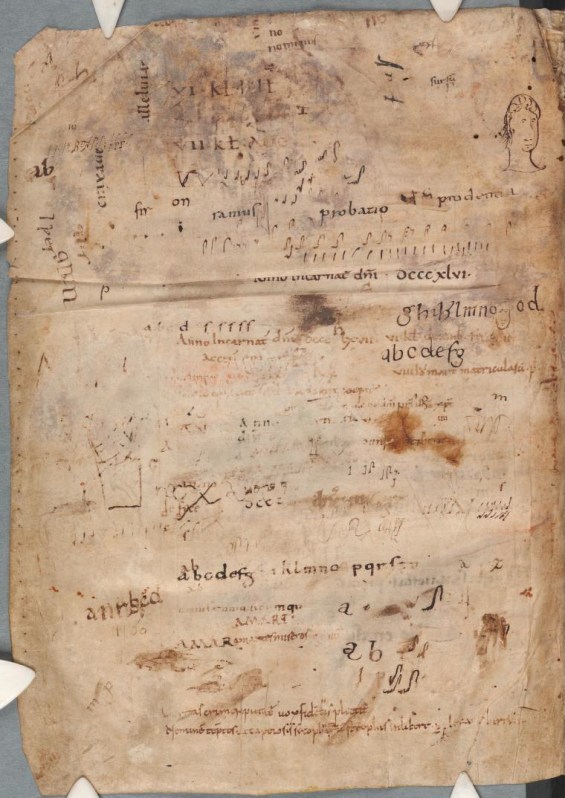
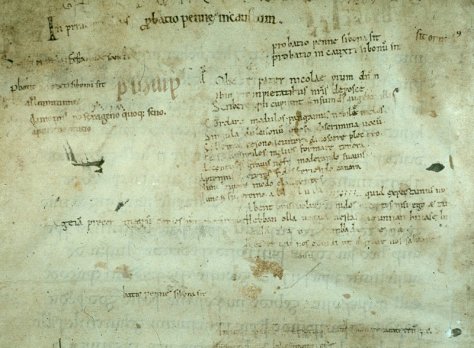
While the pen trials in Figure 3 were executed by perhaps two or three individuals, there could be far more scribes involved. Figure 4 shows a page in a ninth-century manuscript. Present in the back of the last quire, it was left blank because the text had already ended. Some three centuries later, likely in the second half of the twelfth century, the page was filled with pen trials by least fifteen scribes. We are probably looking at a group of individuals in the same scriptorium, who favoured very different “doodles” for testing their pen, from alphabets to a small portrait. And the musical notation appears as well, at various locations. A similar case where a large group of individuals share the same empty page is found in a set of manuscripts from Rochester Priory in Kent, now Oxford, Bodleian Library, MSS Bodley 340 and 342 (Figure 5). Several individuals from the early twelfth-century wrote down short passages on their flyleaves, including – with a peculiar sense of appropriateness – the phrase probatio pennae, “I test my pen” (near the top of the detail shown in Figure 5).

Oxford_Bodley 340
Figure 5. Pen trials by several twelfth-century scribes in Rochester Priory, Kent (Oxford, Bodleian Library, MS Bodley 340, f. 169v, detail).

Groups of pen trials from a medieval scriptorium can be important sources of information about scribal practices and the backgrounds of scribes. Those in the back of Bodley 340 and 342, for example, show that the scriptorium of Rochester Abbey was filled with individuals who were trained across the European Continent, including in Germany, Holland and Italy (see Kwakkel, “Hidden in Plain Sight”). This verdict is based on the letter shapes of the pen trials, which reveal where their makers are from: scribes were trained to produce slightly different letter shapes all over Europe, which shows in the pen trials. By proxy, the page in Figure 5 highlights the ethnical diversity of the monks in Rochester Abbey.

Test Sheets

Sometimes one encounters truly special collections of pen trials. Leiden University Library holds a loose double-leaf filled with an unusual amount of them (Figure 6). Its existence adds significantly to our understanding of medieval pen trials. One may be inclined to think that scribes always turned to empty pages in the back of existing manuscripts and filled them pen trials. While this happened, as the previous cases show, there is also another practice at play. The Leiden sheet suggests that scribes also used loose – i.e. unbound – sheets, which likely lay on their desk. Some of these “test sheets” were repurposed and turned into flyleaves, making it look, to somebody observing the pen trials today, as if they were directly written into the book.

Figure_3_BPL_3327_22
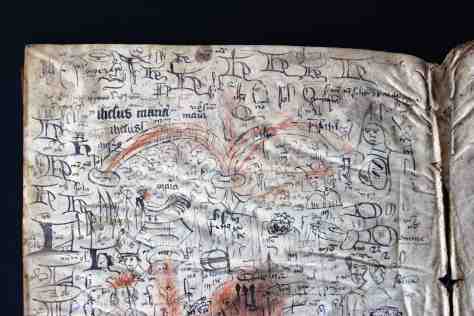
Figure 6. Upper half of a flyleaf filled with dozens of pen trials (Leiden, Universiteitsbibliotheek, BPL 3327, 22, 15th century). Photo by the author

This particular test sheet was filled to the brim with several hundred pen trials: there are more than I have ever seen in one location (note that Figure 6 shows only a detail). When one looks carefully, running themes can be observed across the page, sometimes clustered in the same location. There is the large capital letter H that is frequently drawn, especially near the top of the page; and there are recurring human figures as well, such as a grumpy lady, a man with curly hair, and a few bishops. Another theme is the nota sign, the attention sign that is encountered in the margins of manuscripts: quite a few are observed under the two red arches (they look like “nt” with a curly line over top). There are as many as ten individuals at work on this sheet, which suggests this sheet, too, was used in a scriptorium.

Figure_4_PER_16
Figure 7. Fifteenth-century test sheet used as flyleaf (Leiden, Universiteitsbibliotheek, PER 16). Photo by the author

Another test sheet is seen in Figure 7. It was used by a single scribe, who used the crumbly sheet to write down letters, parts of religious verses, and non-sensicle expressions. Here the earlier purpose is clearly visible through the rough and well-used appearance of the flyleaf. It concerns a piece that was ripped off of a larger paper sheet and subsequently used for testing the pen. At a later stage it was repurposed as a flyleaf. Figures 6 and 7 show us the far ends of the spectrum of medieval test sheets: some were inhabited with words and doodles by a group of individuals, as indicated by the variations in ink color, letter shape, and nib width, while others were tools used by single scribes.

This is an expanded and modified version of a post that first appeared on Leiden Medievalists Blog.

Read more about pen-trials:

Erik Kwakkel, “Hidden in Plain Sight: Continental Scribes in Rochester Cathedral Priory, 1075-1150,” in Writing in Context: Insular Manuscript Culture, 500-1200, ed. Erik Kwakkel, Studies in Medieval and Renaissance Book Culture (Leiden: Leiden University Press, 2013), 231-61.

Me, Myself, and I: The Story of Two Medieval Selfies

Cologny_Bodmer_127_244r_detailSelfies are by no means an exclusively modern phenomenon. As shown in a previous post on medieval selfies, some decorators made self-portraits in manuscripts, showing that the practice predates print – albeit without the use of a camera. They did so to identify themselves as the creator of a miniature or historiated initial, or even to exhibit their accomplishments as businessmen, as the early-sixteenth-century commercial illustrator Nicolaus Bertschy appears to do. Other medieval examples of selfies are those by Matthew Paris, the thirteenth-century monk from St Albans, painted in the lower margin of his Historia Anglorum (see here).

That earlier blog post includes two intriguing selfies made by the same person, a monk who calls himself Rufillus. One is found in a copy of Ambrose’s Hexaemeron kept in the Bibliothèque municipale in Amiens as MS Lescalopier 30 (Figure 1). The text discusses the six days of the Creation and Rufillus displays himself inside a green – and rather confined – initial letter D at the outset of the section on the Third Day. Why he shows himself here, when the Hexaemeron is about to discuss the creation of plants and material forms, is unclear.

Amiens, BM, Lescalopier 30, fol. 29v
Figure 1. Rufillus inhabiting a letter D (Amiens, Bibliothèque municipale, Lescalopier 30, fol. 29v, late 12th century). Source

His other selfie is encountered in Cod. Bodmer 127, a collection of saints’ lives kept in the Fondation Martin Bodmer in the Swiss city of Cologny (The Passionary of Weissenau, Figure 2). Here, Rufillus created a more roomy environment, painting himself inside a very large letter R at the outset of the passion of St Martin of Tours (d. 397). Selfies are not frequently encountered in medieval manuscripts, which makes the Rufillus case quite special, given that it entails not one but two “snapshots” of the same person. This post explores what we can learn from the two self-portraits of a monk who is a bit of a showoff – and who is not shy about using the selfie-stick.

Cologny, Fondation Martin Bodmer, MS 127, fol. 244r
Figure 2. Rufillus inside a letter R (Cologny, Fondation Martin Bodmer, Cod. Bodmer 127, fol. 244r, late 12th century). Source

Rufillus the Illuminator

Helpfully, Rufillus identifies himself by providing his name: in the Cologny manuscript he painted it in white above his brush (accompanied by “Fr.” for frater, monk), while in the crowded Amiens initial the name is written right above the decorative letter with pen and ink. Based on the origins of the two manuscripts, scholars place Rufillus in the late-twelfth century Premonstratensian abbey of Weissenau near Ravensburg in the South of Germany (get up to speed on Rufillus in this article by Solange Michon; a useful enumeration of manuscripts from Weissenau is found here). In secondary literature he is commonly regarded (and explicitly labeled as) an illuminator (see for example here and here). Judging from the decoration in the two manuscripts, which include numerous decorated initials and even some full-page miniatures, he was quite accomplished. In his article Michon shows, by highlighting iconographical – design – parallels, that it is the same person who produced the decoration in both manuscripts.

The Cologny manuscript shows the artisan “in the moment,” hard at work decorating the manuscript (Figure 2). The scene is unusually rich in detail and shows us, among other things, what tools were used by medieval illuminators. In one hand Rufillus is holding a bowl filled with red paint; in the other a brush. Cow horns filled with all kind of paints are placed behind him, while a mortar and pestle are placed nearby for preparing additional pigments. In what is a familiar pose for painters today, his right hand is leaning on his left for stability. That hand is in turn supported by a stick placed on the ground – a selfie-stick! With a healthy dose of irony, Rufillus allows us to observe him as he is painting the initial he is inhabiting. In a rather unusual twist, we witness both the artist at work and the result of his toils. By showing himself applying red paint on the letter R he invites the beholder in his atelier, which is a powerful gesture.

Amiens_Lescalopier_30_detail
Figure 3. Rufillus’ name in Amiens, Bibliothèque municipale, Lescalopier 30, fol. 29v. Source

Rufillus the Scribe

While the common designation given to Rufillus by scholars is illuminator or decorator, the second selfie suggests that he was also a scribe. After all, in as much detail as he presents himself as an illuminator in the Cologny manuscript, he shows himself as a scribe in the Amiens codex (Figure 1). In this depiction, too, the paraphernalia of the trade are clearly identifiable, this time the scribe’s: a sheet of parchment, a reed, and a knife to hold down the parchment as well as to cut the nib of the pen. While Rufillus placed himself on a bench in the Cologny painting, the Amiens scene shows him seated in a scribal chair, one that supports his behind as well as the parchment sheet he is writing on. It seems appropriate, in this light, that Rufillus signed his name with pen rather than brush: he stayed in his role. The key observation to make here, however, is that our monk appears to have been active both as illuminator and scribe in the scriptorium of Weissenau (more about such a combination here).

The name “rufillus” written above the Amiens painting provides additional information. Let’s look at it again, this time from up close (Figure 3). The ink used for his name has a brown colour, deviating from the deep-dark black ink of the main text. In other words, main text and name were copied at different moments. The same is suggested by the observation that the pen used for writing the name was much thinner. Moreover, the nib used for the name reveals an imperfection not seen in the main text: the flawed nib produced a thin white line in the central stroke of the letter l. This is obviously a later cut or even a different pen. These observations make sense. In the production of a manuscript the copying of the text came first, followed by the execution of the decoration.

Evidently, Rufillus signed his name when he completed the painting, not while he was copying. This is telling, I think. Rufillus could have identified himself better and more explicitly through a scribal colophon, which is where copyists provide details about themselves (see this post). By contrast, he is far less traditional and added his presence not with pen but with brush. By doing so he inserted the motif of the scribe into the visual narrative of the book, even though its topic did not call for it. This somewhat inappropriate behaviour is amplified by the fact that he then identified this scribe as himself. Through his action, Rufillus squeezed himself into Ambrose’s text and climbed onto the podium of the Church Father. He purposefully attracted attention to his person.

Rufillus_StGall127_AmiensLescalopier30
Figure 4. The monk Rufillus in two historiated initials (Amiens, Bibliothèque municipale, Lescalopier 30, fol. 29v, left, and Cologny, Fondation Martin Bodmer, Cod. Bodmer 127, fol. 244r, right).

Rufillus the Person

Each of the two manuscripts shows that Rufillus is not lacking in confidence and that he does not mind breaking with the monastic virtue of modesty. It is in the combination of the two selfies, however, that we learn things we otherwise would not have known about him. For example, with Amiens alone we could not be sure that Rufillus produced the decoration in the manuscript as well. After all, the decorator could have produced a portrait of his colleague the scribe, in praise of his activities, or even a generic picture of a scribe at work. Had Cologny been by itself, there would not have been a reason to infer that Rufillus was also involved in scribal activities. Where the two selfies really become quite telling, however, is in the realism they entail. There are striking commonalities that suggest the decorator aimed to provide a realistic depiction of himself, which fits the bill given his pronounced self-promotion.

Striking similarities in his appearance are for example the pronounced eye lids, the shape and colour of his hair (bright red and with recesses), and the sharp lines across the cheeks, starting next to the nose and giving his face a thin appearance (Figure 4). With only one selfie the red hair would have been striking, but the repeated occurrence suggests that Rufillus really was a red-headed monk. This is, of course, why our scribe-illuminator calls himself Rufillus, which is derived from the Latin rūfus, meaning “red-haired” (see also here). In other words, our scribe-illuminator is using a pseudonym, one derived from a pronounced feature in his appearance – his hair. For a person who should strive to be modest and for whom the monastic community ought to be more important than the individual in it, relating one’s identity to a bodily feature seems peculiar. Yet, in light of what we have learned about Rufillus, it is no surprise.

Bloomington_LillyLibrary_Ricketts20
Figure 5. Peter Lombard, bishop of Paris, shown as scribe (Bloomington, Lilly Library, Ricketts 20, fol. 1v, c. 1200-15). Source

Rufillus the Old Man?

A third manuscript exists that was copied and illuminated by our anonymous red-headed monk, although it is not usually mentioned in discussions about Rufillus and his self-portraits. The codex in question is Bloomington, Indiana University, Ricketts 20 (Peter Lombard, Commentary on the Psalms), which is assumed to have been produced in c. 1200-15, a few decades after Amiens and Cologny, and which was part of the library of Weissenau Abbey (Figure 5). In the description of the manuscript in his Gilding the Lilly (p. 60), Christopher de Hamel identified the scribe and illuminator as Rufillus (his assessment is quoted in this manuscript description). One can see from the handwriting that Rufillus was older when he made the Bloomington manuscript: his firm hand, with which he once produced such sharp and disciplined script, appears shaky and weak.

Bloomington_Lilly_Ricketts 20
Figure 6. Bloomington, Lilly Library, Ricketts 20, fol. 45v (c. 1200). Source

Another initial letter in the same manuscript provides a bit of history about its origins (Figure 6). A person is shown holding an open book in which the following is written: “Rodolfus plebanus de Lindaugia. q[ui] nobis dedit hu[n]c libru[m],” “Rudolf, parish priest of Lindau, who gave us this book” (source, with minor correction in the transcription). The painting shows the person who “gave” the manuscript to Weissenau abbey. Because the maker of the book, our Rufillus, is commonly regarded as a monk of Weissenau, this inscription would suggest that Rudolf paid for the materials, which is a bit of stretch but possible. Had our anonymous monk not been so firmly tied to Weissenau abbey in secondary literature, this inscription could indicate that Rufillus and Rudolf were one and the same person: he first made the manuscript, then donated it to the abbey. If this speculative inference were true, it would place our red-headed scribe-illuminator outside the abbey of Weissenau – and turn the letter O in Figure 6 into a third selfie, showing Rufillus as an old man.

Rufillus and the Weissenau scriptorium:

  • Jonathan James Graham Alexander, Medieval Illuminators and Their Methods of Work (New Haven & London: Yale University Press, 1992), pp. 16-17.
  • Walter Berschin, “Rufillus von Weissenau (um 1200) in seiner Buchmalerwerkstatt,” in: Walter Berschin (ed.), Mittelateinische Studien II (Heidelberg: Mattes Verlag, 2010), pp. 353-56.
  • Christopher de Hamel, Gilding the Lilly: A Hundred Medieval and Illuminated Manuscripts in the Lilly Library (Bloomington: The Lilly Library, 2010), p. 60.
  • Solange Michon, “Un moine enluminateur de XIIe siècle: Frère Rufillus de Weissenau,” Zeitschrift für schweizerische Archäologie und Kunstgeschichte 44 (1987), 1-7.
  • Solange Michon, Le Grand Passionnaire enluminé de Weissenau et son scriptorium autour de 1200 (Genève: Slatkine, 1990).
  • Elke Wenzel, Die mittelalterliche Bibliothek der Abtei Weißenau (Frankfurt am Main: Peter Lang, 1998).

Selfies and self-portraits:

The Architecture of the Medieval Page

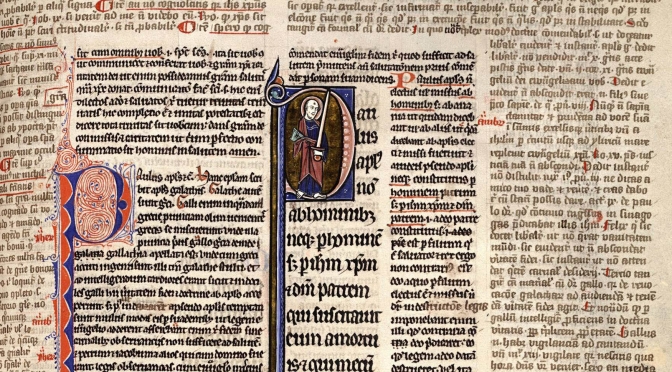
It may seem a stretch to compare page design with architecture, but the comparison really works, I think. Looking at the medieval page, it is not difficult to regard it as an engineered construction: a convoluted space defined by columns and corridors, with rooms inhabited by thoughts and ideas (Figure 1). Nothing encountered on the medieval page is a coincidence. Everything is there for a reason and serves a specific purpose; and so, too, is the manner in which the text was spread out over the page. Like other material features of the manuscript, page design is usually reflective of how the book would be used, but in their choices scribes also responded to the preferences – demands, even – of the individuals who would ultimately use the manuscript.

Readers, in turn, preferred their books – and the pages in them – to be formatted in certain ways because they planned to use them for performing particular tasks: to educate or be educated (teachers and students), to entertain or to be entertained (minstrels and courtiers), or to gather a body of information and consult it (scholars, preachers, physicians, lawyers). How and where words were placed on the page – their size and script, and their location – were important considerations in this process of turning the book into a tool that was up to the task. Indeed, it can be argued that a page’s design was (and is) key to a book’s success. What are some of the variables in play? And how did the choice for a certain design affect, positively and negatively, the manner in which the medieval book could be used effectively?

OXford_Bodleian_LaudLat.9_16r
Figure 1. Oxford, Bodleian Library, Laud lat. 9, fol. 16r (Commentary to the Bible, 1220-30). Source

Blueprint

If the page is a building, its foundation was laid in an early stage of a manuscript’s production. After the scribe had figured out how to tackle a particular book – he knew how it would be used, having had input from the patron or the monastery’s librarian – he would start designing the page by grabbing two tools that were fundamental for what the page would ultimately look like. The first was a pointy device that allowed him to punch holes in the parchment or paper leaves, which appear like dots along the long edges of the book. The second was a tool with which he could add ruling to the page. Up to c. 1150, a sharp object was used to produce gutters – indentations in the parchment – which created pathways for the lines of text flowing out of the pen. After that date a piece of lead or a pen and ink produced the ruling (this miniature shows a scribe using a ruler to produce the ruling; at the top of this post is another).

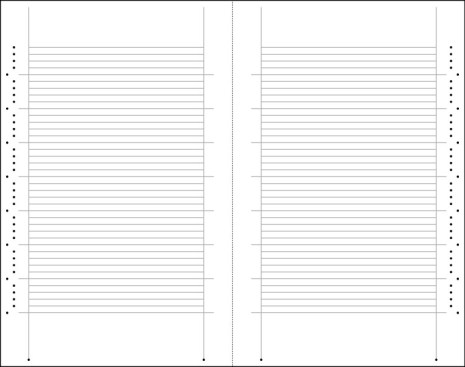
Connecting the dots in this fashion, the scribe placed a web of lines on the page (Figure 2). The resulting grid formed the outline of the future text: it defined – and confined – the number and location of the columns, the number of lines they would hold, as well as the dimensions and positioning of the four margins. Even the ultimate presence of reading aids was construed during this early production stage. An extra line was added in the upper margin to guide the running title, if one was planned, while in preparation for marginal commentaries extra ruling was added to the marginal space (both not present in Figure 2). In a way this grid of horizontal and vertical lines functioned as the blueprint of the manuscript: it defined the ultimate page even before a single letter was written down on it. The still empty lines, yet to be complemented with words, determined what the book would look like and how it could be used later.

ruling_pattern
Figure 2. Ruling pattern, showing two pages with horizontal and vertical ruling, and marginal prickings. Source

Rooms and Corridors

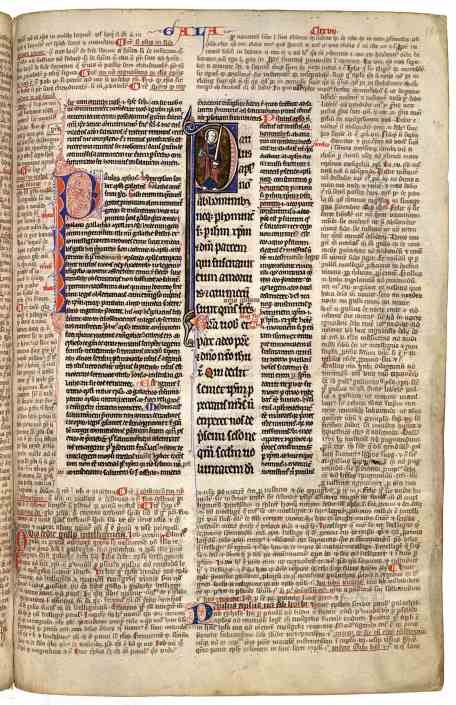
The quill would bring this blueprint to life: it placed words onto the ruling, thus producing text and meaning. The main text of the book could be flanked by commentaries, which in turn formed additional columns. When several commentaries were present, the design of the page can be quite daunting – and must have been a nightmare to produce (see for example Figure 1). However, this complexity is relative. The example in Figure 3 shows a central text column, written in a large letter and deep-dark black ink, which contains the biblical text (the page shows St Paul’s Letter to the Galatians). Around it, in equally dark ink, Peter Lombard’s commentary to St Paul’s letter is encountered. This part was produced in Paris during the second half of the 13th century and illuminated in the Du Prat workshop (source).

The margins around this text and commentary remained empty until 1412, when an additional commentary by Peter Tarentasia was added to the page in a smaller script. The result is a complex page, but also a remarkably organised one. After all, the information was placed in relatively isolated text compartments – “rooms,” as it were – which were separated by blank corridors. In other words, it was crystal clear to the reader what was what: the larger size of the letter identified the main text, while the smaller script of the commentaries as well as their positioning on the page, identified the occupants of the other rooms. Complex manuscripts like these, which present a textus inclusus or “square-bracket” glossing pattern, contain pages inhabited by a maze of corridors, which “snake” between the columns and sometimes even underneath or above them.

Figure_1_KBH_71A22_180r_low-res
Figure 3. The Hague, Koninklijke Bibliotheek, 71 A 22, fol. 180r (Lombard, Glossa in epistolas Pauli, 1250-1300). Source

Pillars

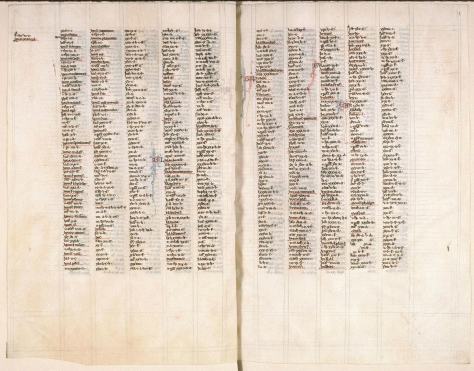
The manuscripts in Figures 1 and 3 are so complex that it is difficult to say how many text columns they consist of. Evidently, however, in both cases the main text is copied out in a single column, a firm pillar written in a bold letter. Most medieval manuscripts hold either one or two columns of main text. Three or four are occasionally encountered. Usually it concerns a dictionary or encyclopedia (read about an example of four columns here). A page with more than four columns is extremely rare. In fact, I only know of one such manuscript (Figure 4). It is kept in Amiens and holds a concordance of the Bible, a tool that enabled readers to identify where in the Bible certain concepts and figures were mentioned.

The entries in this manuscript – often a name followed by a bible book and a chapter number – are short, which is why the scribe decided to place five of them on a single page. The book measures 310×208 mm and is thus not even unusually large, which tells you just how small the script is. Equally remarkable, the page has room for a sixth column, which is crammed into the outer margin. Here the reader could add remarks; one was added on the spread seen in Figure 4, all the way in the top left corner. In the lower margins, too, there is room planned for comments. A grid of square boxes is seen here, produced by pencil lines. This is a popular design for university textbooks, which contain many such penciled squares, sometimes over forty of them on one page. They act as comment boxes in which the student could jot down his notes (this is an example of such a manuscript; more about this practice in this blog post).

Figure_2_Amiens_BM_95_31v-32r_low-res
Figure 4. Amiens, Bibliothèque municipale, 95 (Concordance, c. 1300). Source

The page as a house, the scribe as its architect: they are attractive comparisons, which highlight just how much an effective page depended on crafty design, careful planning, and meticulous calculations. Like an architect, the scribe made sure to create a comfortable home for future inhabitants.

More on medieval page design:

Raymond Clemens & Timothy Graham, Introduction to Manuscript Studies (Ithaca/London: Cornell University Press, 2007), pp. 14-17 (“Preparations prior to writing”). Discusses layout and the preparation of the sheets.

Erik Kwakkel, “Decoding the Material Book: Cultural Residue in Medieval Manuscripts,” in The Medieval Manuscript Book: Cultural Approaches, ed. Michael Van Dussen and Michael Johnson (Cambridge: Cambridge University Press, 2015), 60-76. Discusses the rationale behind the choice of a manuscript’s materials features.

Erik Kwakkel, Books Before Print (Leeds: Arc Humanities Press, 2018), pp. 30-70 (“Filling the Page: Script, Writing, and Page Design”). Overview of page design through case-studies.

Elaine Treharne, “The Architextual Editing of Early English,” in A. G. Edwards and T. Takako (eds.), Poetica 71 (2009), 1-13. Architectural context used as a metaphor in the editing of medieval texts.